

Grumentum Archaeological Park
A place to cross slowly
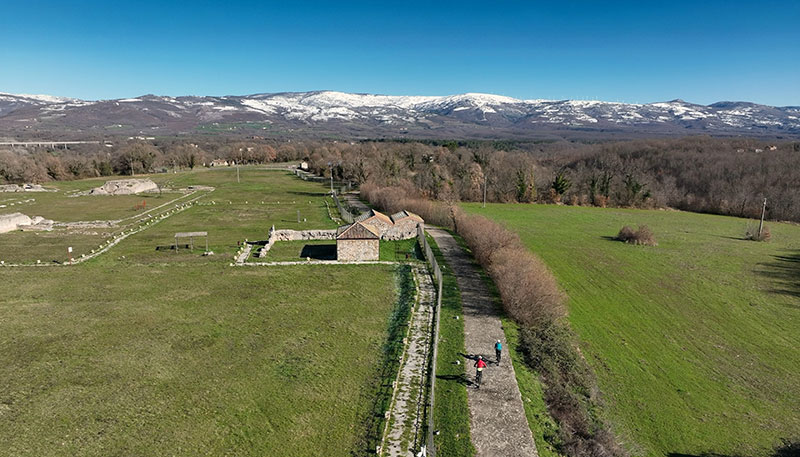
Located within the Lucanian Apennines Val d'Agri Lagonegrese National Park, the Grumentum Archaeological Park is an unmissable destination and one of the most extraordinary archaeological sites in southern Italy. Here, visitors have the rare opportunity to see, at a glance, the complete layout of an abandoned Roman city that was never resettled, an exceptional case comparable to only a few other examples on the peninsula. Grumentum still retains the legible form of an ancient city, with a clear distinction between public, religious and private spaces, set in a highly evocative landscape.
The city stood on a large river terrace naturally defended by the Agri and Sciaura waterways and dominated the valley from above, overlooking what is now Lake Pertusillo. Its strategic and panoramic position explains the importance of Grumentum as a territorial control hub and urban centre of reference for the entire upper Val d'Agri.
The urban layout follows a regular pattern, typical of Roman planning: a network of orthogonal streets, with decumani and cardini, which organised blocks, public buildings and residential neighbourhoods. The decumanus maximus, still largely preserved, was the main axis of the city, along which the most representative monuments of civil and religious life were located.
Among these, the theatre stands out, built in the Julio-Claudian era and subsequently restored, one of the most easily recognisable in southern Italy. The cavea, orchestra and stage tell of the central role that performances and public life played in the Grumentina community. Behind the theatre was a porticoed area, probably also used as a gymnasium, flanked by an Italic-style temple, perhaps dedicated to a deity of Egyptian origin, evidence of a complex and cosmopolitan religious landscape.
Continuing along the decumanus, we come to the Domus dei mosaici, a private residence of exceptional value, which belonged to a high-ranking figure. The house preserves splendid mosaic floors, wall decorations and rooms organised according to the Roman model of the atrium and peristyle, offering a vivid insight into the daily life and aesthetic taste of the urban elite between the 2nd and 4th centuries AD.
The beating heart of the city was the Forum, a large rectangular square with porticoes on all sides, the hub of political, administrative and religious life. Here stood temples, civil buildings and spaces dedicated to commerce and justice, including the Capitolium and other sacred buildings, some of which are still being excavated. Not far away were the baths, including the Imperial Baths, one of the best-preserved bath complexes in the Roman world, embellished with mosaics of extraordinary quality, such as the famous one depicting Scylla, the Giants and marine motifs, symbolising the link between water, myth and well-being.
On the edge of the town stands the amphitheatre, built taking advantage of the natural slope of the land and intended for gladiatorial games and public spectacles that attracted spectators from all over the valley. Its structure, partly carved into the slope and partly built in masonry, testifies to the ingenuity of Roman engineering and the social importance of collective events.
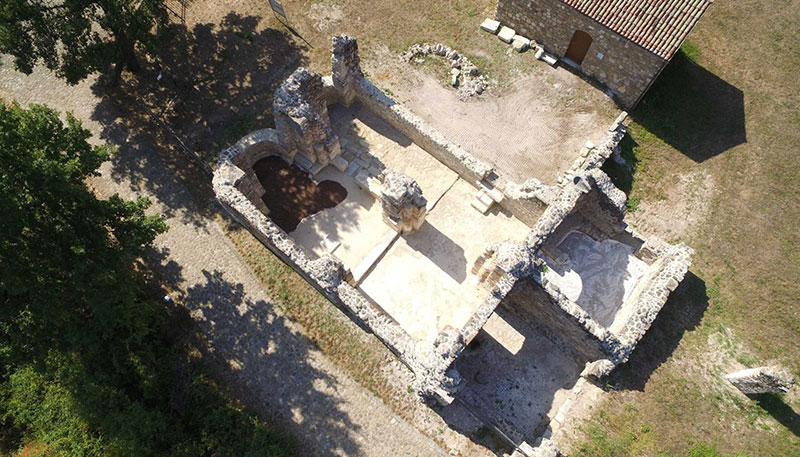
Finally, on the route from the amphitheatre, continuing towards the interior of the park in the northern part of the Roman settlement, you can admire the remains of the Cathedral of Santa Maria Assunta, which was most likely the first cathedral of the Grumentina bishopric, attested with certainty between the end of the 4th and 5th centuries AD. It is mentioned in a letter from Pope Gregory the Great as 'parochiae ecclesiae Grumentinae'.
A visit to Grumentum is naturally complemented by a visit to the nearby National Archaeological Museum of the Upper Val d'Agri, which preserves and interprets finds from the city and the surrounding area. The museum takes visitors on a journey spanning over half a million years, from prehistory to late antiquity, providing a complete picture of the environmental, cultural and settlement evolution of the valley. Fossils, Bronze Age materials, Lucanian grave goods, Hellenistic and Roman artefacts allow us to understand how Grumentum was part of a wide-ranging network of economic, cultural and religious relations.
Together, the Archaeological Park and the Museum are unique in the Lucanian landscape: a continuous narrative that combines natural landscape, ancient city and historical memory.
Grumentum is not just a site to visit, but a place to be explored slowly, where the stratification of time emerges powerfully and interacts with the surrounding environment, making it clear how the history of man and nature are deeply intertwined in this area.