
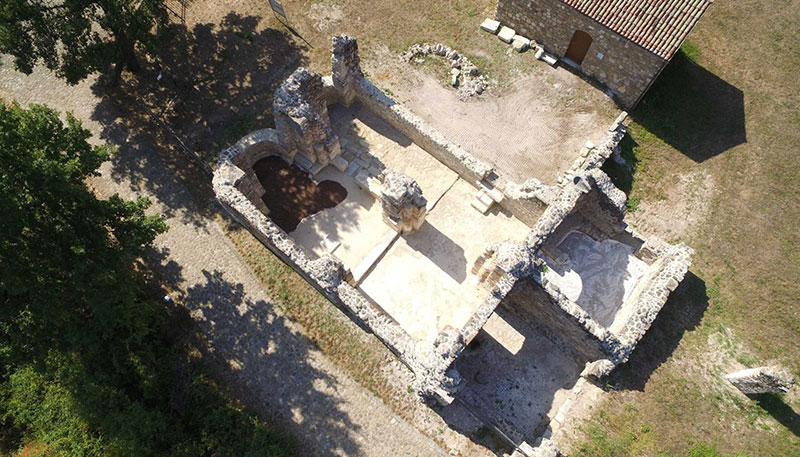
The Basilica of Santa Maria Assunta
And it is precisely the Grumentum Archaeological Park that houses another Christian heart: the Basilica of Santa Maria Assunta. When the city embraced Christianity, the Basilica of Santa Maria Assunta became the religious, symbolic and administrative centre of the transformed city.
Built in the northern part of the Roman settlement, along the main road, the church was most likely the first cathedral of the Grumentina bishopric, attested with certainty between the end of the 4th and 5th centuries AD and remembered by Pope Gregory the Great as 'parochiae ecclesiae Grumentinae'.
The original building, with three naves and three apses with a narthex, reflected a monumental layout of clear early Christian origin, which was subsequently remodelled and reduced to two naves, but never completely abandoned. Archaeological excavations have revealed evidence of a long continuity of life: ceramics, structures and decorations document a period of use from Roman times to the 19th century, well beyond the decline of the ancient city.
In the central nave, a small underground room, probably a crypt, has also been discovered, with the remains of burials, a sign of a deeply rooted cult and funerary function. Particularly striking are the medieval frescoes, fragments of a pictorial cycle dating from between the 13th and 14th centuries, when the church was still active: among these, the delicate face of a saint in prayer stands out, testimony to a devotion that has spanned the centuries.
Together with the suburban sanctuaries of San Marco, near the southern necropolis of the city, and San Laverio, near the north-western necropolis, the Basilica of Santa Maria Assunta reveals the face of a Christian Grumentum which, despite changing form, remained a spiritual and territorial reference point for the entire Val d'Agri for a long time.