

Tito
Where ancient history meets the silence of the mountains
On the outskirts of Potenza, nestled within the landscapes of the Lucanian Apennines, Val d’Agri and Lagonegrese National Park, Tito is a village that blends history and nature, suspended amidst mountains, woods and spring waters. Here, time seems to pass at a different pace, woven from ancient tales and vistas that invite you to explore at a leisurely pace.
Dense woods, footpaths and mountainous terrain create the perfect setting for walks and moments of immersion in nature. Not far from the village, in the hamlet of Acqua Bianca, sulphurous springs gush forth, known since ancient times for their beneficial properties: a picturesque spot where water and stone tell of an ancient bond between man and the land.
The origins of Tito are lost in the mists of time, amidst Iron Age settlements and references to the Roman and medieval worlds. Its very name is shrouded in mystery: it may derive from ‘Tutus’, meaning a safe, fortified place, or from ‘Titulus’, meaning a boundary, suggesting a land of passage and encounters. What is certain is that the history of the village has been marked by intense events: from the destruction of Satrianum in the 15th century, which brought new inhabitants to these hills, to the earthquakes that have repeatedly reshaped its face. Among the most powerful chapters of the collective memory are the republican uprisings of 1799, when Tito became a scene of courage and sacrifice, embodied by the figure of Francesca Cafarelli De Carolis.

The historic centre still preserves traces of this layered history. In Piazza del Seggio, the civic heart of the village, stands the Town Hall, adorned with an elegant 15th-century Durazzo-style arch. From here, narrow streets and vistas unfold, leading to ancient noble residences such as Palazzo Spera, with its monumental portal and noble coat of arms, and Palazzo Postiglione, a refined example of stately architecture, recognisable by its finely carved stone portal.
But it is as you climb towards the highest part of the town that Tito reveals one of its most precious treasures: the Convent of Saint Anthony of Padua. Founded in the early 16th century, this place tells the story of centuries of spirituality and art. The cloister, with its harmonious arched structure, retains a sense of suspended time, whilst the frescoes – attributed to Giovanni De Gregorio, known as Pietrafesa – narrate episodes from the saint’s life with intense expressiveness. The adjoining church, with its two naves, is a veritable treasure trove: stuccoes, altars, paintings and wooden sculptures interact with one another, creating an emotional journey that traverses faith and beauty. Here, the silence seems to amplify every detail, inviting the visitor to pause in contemplation.
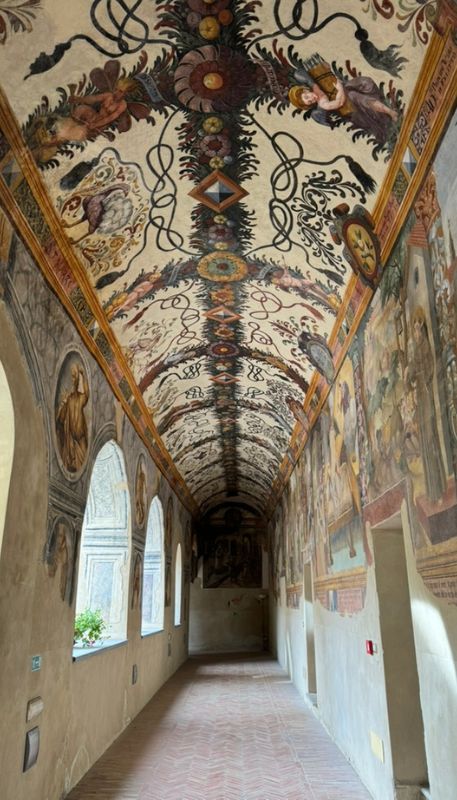
Alongside the grand religious buildings, the area around Tito is dotted with small chapels and churches that bear witness to popular devotion. Among these, the Cappella del Monte Carmine, nestled in the tranquillity of the countryside, is a place steeped in atmosphere: every year, tradition dictates the journey of the Madonna between the sanctuary and the village, in a ritual that unites faith and community. No less significant are the Mother Church of San Laviero, a witness to the village’s seismic history, and the numerous small churches scattered throughout the neighbourhoods, guardians of works of art and local memories.
It is not only its stones and landscapes that reveal the deepest soul of Tito, but also the lives of the men and women who have shaped its history with courage, ingenuity and passion.
Among them all, the figure of Francesca Cafarelli De Carolis (wife of Scipione Cafarelli of Tito) stands out powerfully, a symbol of freedom and determination. A mother and a revolutionary, she chose to side with republican ideals in 1799, paying for her political convictions with her life. Her voice, which rose in a final cry for freedom, continues to resonate today as a powerful echo in the village’s memory, making her one of the most luminous and tragic figures in Tito’s history.

Alongside her, Tito boasts brilliant minds such as Giuseppe Messina, a refined jurist who distinguished himself in the courts of Southern Italy, bringing Lucanian rigour and culture to the highest echelons of the judiciary. His legal works bear witness to a profound and modern way of thinking, capable of leaving a mark on the landscape of Italian law.
And then there is Don Giuseppe Spera, a figure who combines spirituality and culture. A priest, teacher and author, he was a leading figure in a vibrant intellectual era, capable of weaving together faith, teaching and writing. His works and his educational commitment reveal a man who knew how to elevate knowledge to a tool for growth and identity.
Tito is just that: a place where history is never far away, where every stone holds a memory and every view invites you to slow down. A village that surprises with discretion, capable of revealing the most authentic Basilicata, amidst art, nature and identity.