

The Permanent Multi-Scene Nativity Scene in Anzi
A place where faith meets art
In Basilicata, the tradition linked to the representation of the Nativity has taken deep root, taking the form of a simple but powerful story that has fused faith, stone and landscape into a narrative that seems to belong naturally to these ancient lands. Amongst ravines, valleys and villages carved into the rock, the nativity scene becomes a language of identity, a living memory, a story that is constantly renewed.
In Anzi, in the heart of the Lucanian Apennine Park, this vocation takes shape in one of the most spectacular nativity scenes in Europe. Inside the rectory of the Mother Church of San Giuliano, the Presepe Poliscenico Stabile (Permanent Multi-Scene Nativity Scene) is revealed, a monumental work by artist Antonio Vitulli, considered the fourth largest in Europe. Along a wall over thirteen metres long, carved into ten small caves, a visual and spiritual journey comes to life, accompanying visitors through the fundamental stages of Jesus' life, from the Annunciation to his childhood, in a succession of scenes that are illuminated by a sophisticated play of lights, capable of simulating the passage from day to night, from dawn to dusk.
What makes this nativity scene unique is the surprising intertwining of sacred history and the soul of Basilicata. Bethlehem dialogues with the Sassi di Matera, Nazareth is transformed into the alleys of Anzi, and the announcement to the shepherds takes place under the gaze of the Lucanian Dolomites and Castelmezzano. Calvello, Potenza, urban views and mountain landscapes are naturally woven into the Gospel story, creating a symbolic geography where Basilicata becomes the Holy Land. At the centre of the work, the cave of the Nativity is carved out of limestone rock from the Anzi river, which is thought to have been formed around 1,500 years ago, adding a further level of authenticity and charm.
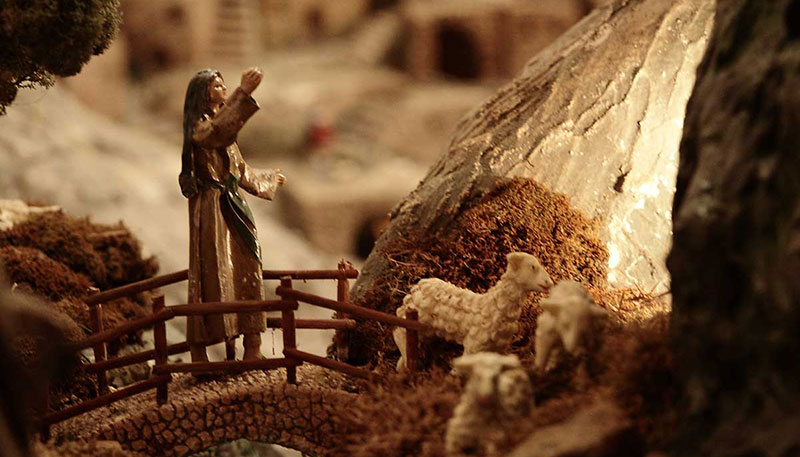
Every detail is the result of patient craftsmanship: over 1,600 hand-modelled red copper tiles, cobblestone pavements, wrought iron street lamps, porticoes, temples and palaces that convey the solemnity of Jerusalem and Herod's court. The skilful use of recycled materials and plaster, combined with meticulous attention to perspective, makes the work not just a nativity scene, but a true permanent artistic installation. Inaugurated in 1997 after years of work, the Poliscenico di Anzi Nativity Scene was the first monumental nativity scene in Basilicata and continues to attract thousands of visitors every year, becoming one of the most recognisable symbols of Christmas in Lucania.
Set in a historic centre already rich in charm, among churches, alleys and mountain views, this nativity scene is not only a destination to visit, but an experience to be savoured slowly, letting yourself be guided by the light, the narrative and the silence.
A place where faith meets art, and where Basilicata recounts, scene after scene, its own personal Bethlehem.