

The Church of Santa Maria degli Angeli
On the road that runs alongside the village, surrounded by greenery and tranquillity, stands the Church of Santa Maria degli Angeli, built in 1622, one of the most fascinating places in Brienza's artistic heritage.
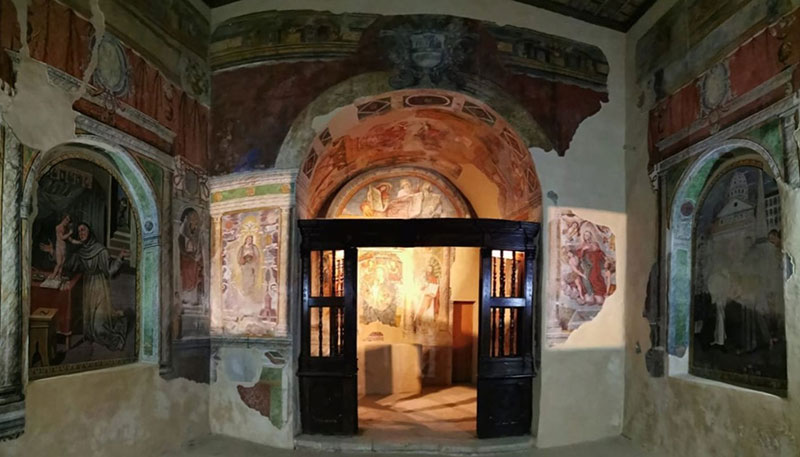
The interior of the church is distinguished by its coffered ceiling, which is still largely intact, and its rectangular nave, in which a monumental wooden balustrade stands out inside the triumphal arch, solemnly separating the presbytery area from the rest of the hall. The decoration of the votive chapel was entrusted to one of the most important interpreters of sacred iconography in 17th-century Lucania: Giovanni De Gregorio, known as Il Pietrafesa, from the ancient name of his homeland, Satriano di Lucania, where he was born around 1579.
The oldest part of the frescoes, characterised by rich ornamentation reminiscent of the elegant ceremonial decorations of the time, depicts various episodes from the lives of St. Francis of Assisi and St. Anthony of Padua on the walls of the nave. On the triumphal arch and in the presbytery, on the other hand, there is a figurative cycle inspired by the Old and New Testaments, with scenes dedicated to the Virgin Mary.
Over the centuries, the complex was enlarged with the construction of a Lazzaretto (lazaretto) for civic functions and two noble funeral chapels. These structures, together with the church, now form the monumental complex of Santa Maria degli Angeli, recognised as an essential part of Brienza's historical and artistic heritage and protected by the Ministry of Cultural Heritage since 1993.
The building of the ancient Lazzaretto now houses the MuLabo, the Museum Laboratory of Arts and Landscape, established by the social cooperative Basilicata Culture, which promotes and recounts the territory through exhibitions and multimedia displays, cultural activities, workshops and seminars that have led to the Mulabo being named a CEAS - Centre for Environmental Education and Sustainability.