

Gallicchio Vetere
A place where ancient Lucania continues to tell its story
On a bright plateau overlooking the Agri valley, in the Lucanian Apennine Park, among oak woods, cultivated fields and ancient silence, stands Gallicchio Vetere, a place where legend and archaeology intertwine in a fascinating story that spans centuries of Lucanian history.
According to tradition, this was the site of an ancient settlement destroyed in remote times – perhaps during Saracen raids, perhaps in more ancient times linked to the great crises of the Roman world - giving rise to the current centre of Gallicchio. According to an ancient popular tradition, preserved in various manuscripts, a local shepherd betrayed his village by showing the Saracens, led by the commander Orlando, a hidden passage between the rocks. Through that narrow secret passage - now known as Scaliell d'Orlando, in the Piagge district - the invaders reached the village of Gallicchio Vetere, beginning the looting and destruction of the ancient settlement.
According to tradition, this was the site of an ancient settlement destroyed in remote times – perhaps during Saracen raids, perhaps in more ancient times linked to the great crises of the Roman world – giving rise to the current centre of Gallicchio. But beyond the myth, the solid and evocative archaeological data tell the story of a Lucanian settlement from the 4th-3rd century BC, deeply influenced by Greek culture and the dynamism of the colonies of Magna Graecia, in particular Heraclea.
Excavations and surveys have revealed a surprisingly rich picture: fragments of achromatic and kitchen pottery, tiles, pithoi, amphorae, oil lamps, black-glazed pottery and even precious remains of Apulian red-figure pottery, together with a quincunx from Luceria dated between 211 and 208 BC. All this tells the story of a lively, organised community that was part of the great economic and cultural circuits of ancient southern Italy. On the plateau stand the remains of a large building divided into regular rooms, constructed with careful techniques and local materials: a true Greek-style farm, with production areas, living quarters, areas for weaving (evidenced by the numerous loom weights), water canalisation systems and cocciopesto floors. It was a self-sufficient microcosm, where domestic life, work and trade intertwined in a balance typical of Hellenised Lucanian settlements.
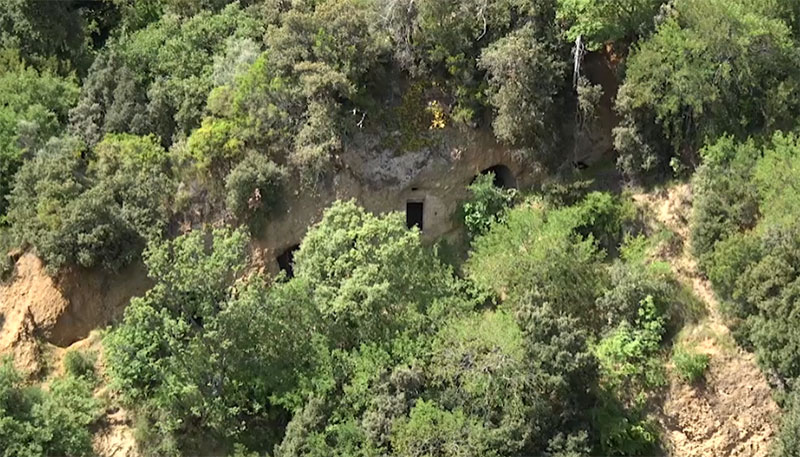
Gallicchio Vetere was not a compact urban centre, but a system of scattered settlements, with large open spaces used for agricultural and pastoral activities: a settlement model consistent with the organisation of the territory in the Agri and Sinni valleys between the 4th and 3rd centuries BC. Here, the indigenous Lucanian culture interacted with the Greek world, absorbing architectural models, ceramic styles and production methods without losing its own identity. A subtle balance between local roots and external influences makes this site a valuable piece in understanding the deep history of inland Basilicata.
The traces also suggest a possible continuity in the Roman era, perhaps linked to the proximity of Grumentum, a large centre in the valley. Much remains to be discovered: the actual extent of the settlement, its internal organisation, the road network and the burial areas. But even today, Gallicchio Vetere tells a powerful story, made of earth, stone and memory.
Around these ruins, the hilly landscape of Gallicchio amplifies the charm of the place: rolling ridges, fields, vineyards, woods and open views towards the Agri create a natural setting that makes the archaeological area not only a site of study but also an emotional experience.
Gallicchio Vetere is not just an archaeological site: it is a threshold between eras, a place where ancient Lucania continues to speak, where every fragment tells a story of people, exchanges, cultures and resistance. It is a small but significant heritage that deserves to be known, protected and recounted as one of the most authentic hearts of the historical memory of the Val d'Agri.