

The Mother Church of Santa Maria Assunta
A few steps from the majestic castle, suspended between sky and rock, the Mother Church of Santa Maria Assunta dominates Laurenzana from a rocky spur that embraces the entire village with its gaze. This is where the spiritual heart of the community has beaten for centuries, in a place that combines history, art, devotion and collective memory, offering visitors an intense and deeply identifying experience.
The origins of the church date back to the 13th century: work began in 1214 and was completed in 1222, at the height of the Swabian era, when the building was consecrated to Sancta Maria de Plateis. Archaeological investigations have revealed even older traces, such as a Gothic-inspired single-lancet window and differences in the masonry that suggest the presence of a Norman tower incorporated into the original structure. With the growth of the village, at the end of the 16th century, the church was enlarged with the addition of the choir and sacristy, a tangible sign of an expanding community and a cult that was increasingly central to the daily life of the people of Laurenzano.
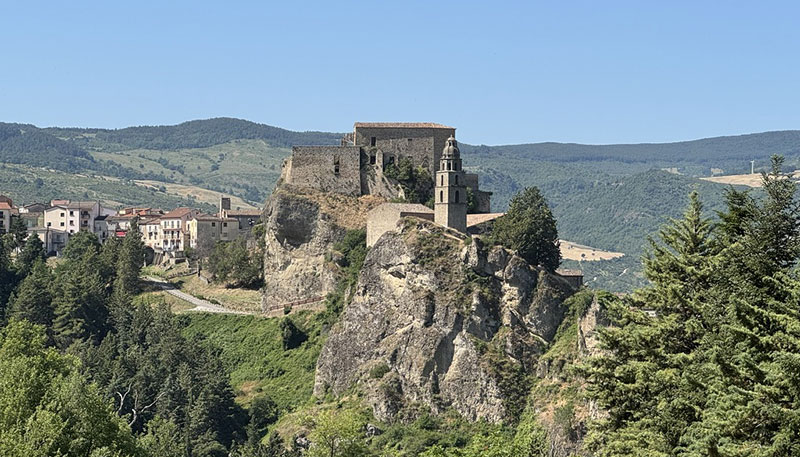
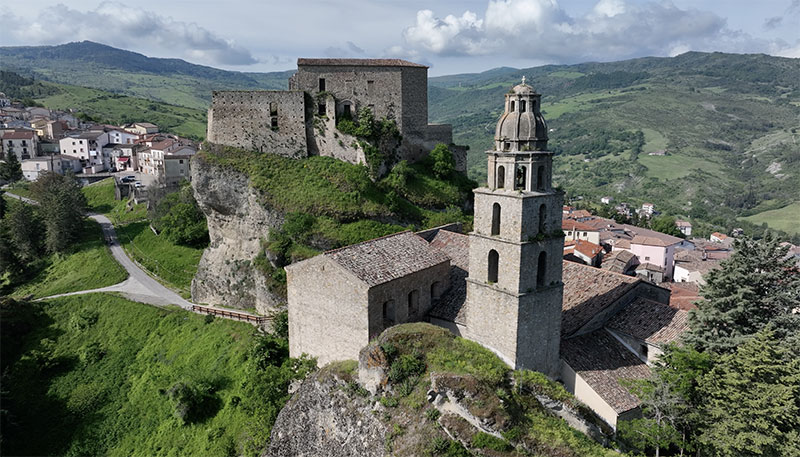
The current appearance of the Mother Church is the result of major 18th-century renovations, when the building was profoundly transformed to occupy the entire cliff. During this period, the bell tower, the large presbytery and the spectacular oval staircase with two flights were built, which still leads to the churchyard today, creating a solemn and evocative entrance. In 1723, the church was reconsecrated with the title of Santa Maria Assunta, while in the following years the main portal and the monumental Cappellone del Santissimo Sacramento (Chapel of the Blessed Sacrament) were built. Restored after the earthquake of 1857 and again between 2010 and 2013, the church retains a sober and elegant exposed stone façade, perfectly integrated into the rocky context.
Crossing the threshold, the three-nave interior reveals an artistic heritage of great value. Stuccoes, friezes and decorations accompany the gaze along the entire perimeter, while above the cornice there are images of the twelve apostles. The coffered ceiling of the central nave houses three large canvases by Umberto Colonna, while the 18th-century wooden choir is embellished with a frescoed ceiling depicting the Assumption of the Virgin, surrounded by saints, cherubs, festoons and cornucopias. There are also paintings from the Lucanian school, including an Adoration of the Shepherds by the painter Girolamo Todisco and an altarpiece with Christ Blessing and the Holy Trinity and Saints, attributed to Giovanni De Gregorio, known as Pietrafesa, and reliquary busts, refined liturgical furnishings in stone and marble, including the ambo and the baptismal font with elegant twisted shafts. Of particular interest is the Chapel of the Blessed Sacrament, which houses a painting of the Madonna and Child flanked by St. Gaetano and St. Filippo Neri, on whose lap appears one of the oldest depictions of Laurenzana.
The Mother Church is also a place of profound popular devotion because it houses the remains of Blessed Egidio da Laurenzana, born Bernardino Di Bello (1443-1518). A humble farmer and hermit, he joined the Friars Minor, choosing a life of poverty, contemplation and spiritual struggle, inspired by Franciscan simplicity. Beatified by Pope Leo XIII in 1880, Egidio is still a much-loved figure today, an example of quiet, everyday holiness, deeply rooted in the religious identity of the town.
During recent restoration work, archaeological excavations have revealed extraordinary evidence of the church's hidden history. Beneath the floor, rooms used for centuries as burial places emerged, according to a practice widespread since early Christian times. Human bones, personal objects, confraternity medals, bronze crucifixes, fragments of fabric, footwear and numerous ceramic finds tell the story of the life and death of generations of Laurenzanians, from the Middle Ages to the modern age. The jugs, Renaissance majolica, coins and everyday objects tell an intimate and touching story, in which the church reveals itself not only as a place of worship, but also as a lived-in, shared space, steeped in human as well as spiritual history.
Every year, on 15 August, the solemnity of the Assumption renews the deep bond between the Mother Church and the community, in a celebration that combines faith, tradition and collective participation. Santa Maria Assunta is not just a monument to visit, but a place to listen to: in its stones, in its works, in the memories preserved under the floor and in the prayers that still inhabit it today, Laurenzana recognises its own soul.