

Viggiano, where the melody of the harp tells the story of a people's soul
In the heart of Val d'Agri, Viggiano welcomes visitors with a unique and unmistakable identity, so much so that it has earned the title of “City of the Harp and Music”. Here, music is not just an art form, but a collective language, a living memory intertwined with the stones of the village. Strolling through the narrow streets of the historic centre, your gaze is captured by the small harps carved on the portals of ancient houses, elegant engravings that tell the story of the musicians and luthiers of Viggiano who made the town famous throughout Europe in the 17th and 18th centuries.
Viggiano had a flourishing ancient musical tradition that was expressed both in the construction of musical instruments, particularly harps - here the luthiers made a type of harp, called arpicedda, which was smaller than the classical harp, making it easier to transport - and in the talent of its itinerant harpists.
It was in these mountains that an extraordinary tradition of wandering harpists was born, capable of travelling across Italy, Europe and even the oceans, becoming true cultural ambassadors. Naples, Paris, London and the Americas became the stops on a journey that brought the name of Viggiano to the most important musical contexts in the world. Many of these musicians perfected their skills in the prestigious conservatories of Naples and Rome, conquering international stages such as the Metropolitan in New York. This was the case for the Viggiano flutist Leonardo De Lorenzo, who established himself as principal flute in the New York Symphony Orchestra under Gustav Mahler and taught at the Eastman School of Music, training important flutists such as Julius Baker.
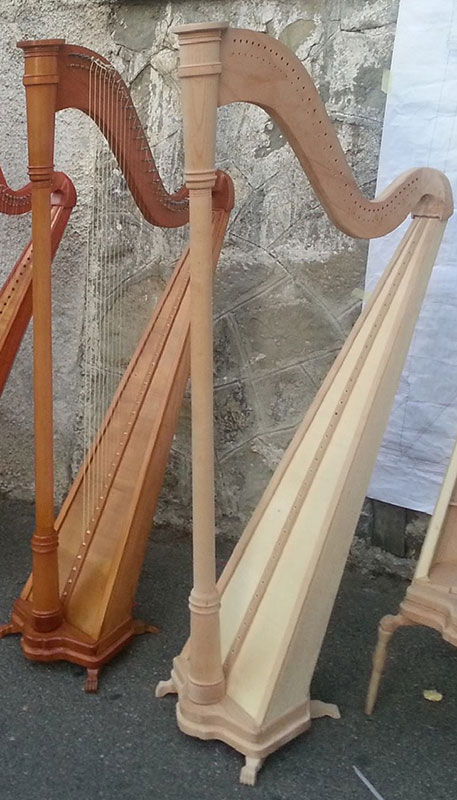
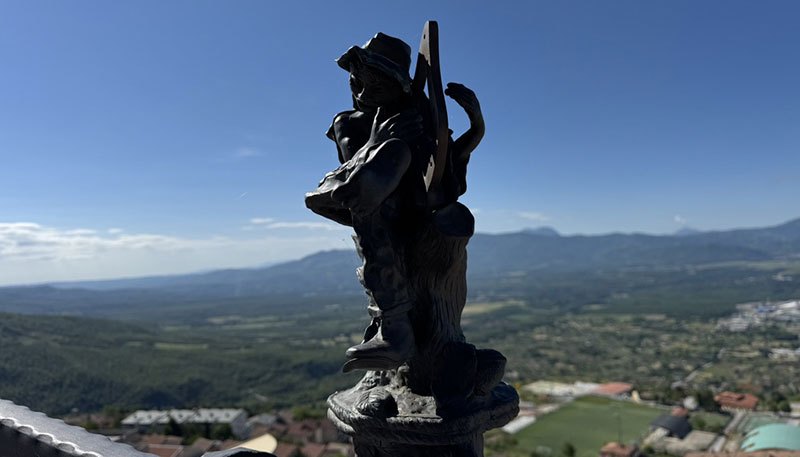
In every family, music was part of everyday life, and the harp, carried over the shoulder along distant roads, became a symbol of identity and hope, as recalled in the verses of the poet Pier Paolo Parzanese: “I have a harp around my neck, I am from Viggiano, the whole earth is my country”.
This legacy has spanned the centuries, leaving deep traces even in the stories of great protagonists of international music. Among these, the story of Victor Salvi stands out. Considered the greatest contemporary harp maker, he is linked to Viggiano through his maternal roots. His story, told in the book Victor Salvi, il signore delle arpe (Victor Salvi, Lord of the Harps) (edited by Biagio Russo, Lavieri, 2023), represents the symbol of a tradition capable of evolving and establishing itself on a global scale, transforming ancient knowledge into world-class excellence. His story, intertwined between Europe and America, testifies to how the Lucanian diaspora was not only a migratory phenomenon, but also a powerful engine of cultural diffusion, capable of leaving a lasting mark on international music and craftsmanship.
After a period of decline in the 20th century, this musical vocation has been revived thanks to important work to recover and promote it. Today, the Scuola Civica dell'Arpa Popolare Viggianese (Viggiano Folk Harp School), housed in the historic Villa del Marchese, the ancient palace of the Sanfelice family, is the beating heart of this revival and also home to a small Music Museum. Here, new generations rediscover the ancient repertoire and learn the secrets of a fascinating and complex instrument, while in the luthier's workshops, harps are reconstructed according to traditional models. The notes of the students thus return to fill the streets of the village, restoring an essential part of the community's soul.
The most intense moment of this journey is repeated every year in the first week of August, when Viggiano is transformed into a large international stage with the Rassegna dell'Arpa Popolare Viggianese (Viggiano Folk Harp Festival). Concerts, seminars and workshops attract nationally and internationally renowned musicians, offering valuable opportunities for meeting and growth. In this evocative setting, music becomes a bridge between past and future, between memory and innovation.
Today, thanks to the commitment of the community, institutions and the Associazione Arpa Viggianese, this centuries-old tradition continues to live on and renew itself. In Viggiano, the harp is not just an instrument: it is the very voice of a land that, wherever you go, continues to resonate throughout the world.