

Abriola
A village nestled among mountains, history and breathtaking views
Perched at an altitude of almost 1,000 metres, in the heart of the Lucanian Apennines National Park Val d'Agri Lagonegrese, Abriola is a mountain village with unspoilt charm, immersed in a constantly changing landscape: from the beech woods of Monte Pierfaone to the Faraglioni, limestone ridges that characterise the south-eastern slope overlooking the valley of the Fiumicello stream, to the sculpted profiles of the Lucanian Dolomites, to the slopes of Volturino. Just outside the town centre is the Piana del Lago, a picturesque area dominated by a small lake where wild horses and grazing animals come to drink. During the winter, thanks to the well-equipped ski areas of Sellata-Pierfaone, it is possible to practise numerous winter sports.
Its origins are lost in time, but reliable information appears around the 9th century, when the Saracens built a strategic stronghold to control the Anzi river valley, traces of which can still be seen in the remains of the medieval walls and the gate with a quadrangular tower, known as Portello. The layout of the ancient inhabited centre, with its narrow, irregular streets, still evokes the atmosphere of the original Arab quarters, even though it was transformed several times during the Swabian and Angevin periods. In the 12th century, Abriola became a fiefdom and passed into the hands of various noble families, including the Caracciolo and Federici families. At the beginning of the 19th century, the latter were involved in one of the most dramatic episodes of brigandage in the area: the murder of the entire family by the gang of Rocco Buonomo, known as Scozzettino. A chronicle of what happened is contained in 'Il brigantaggio del 1809' (Banditry in 1809), Potenza 1911, by Vittorio Di Cicco.
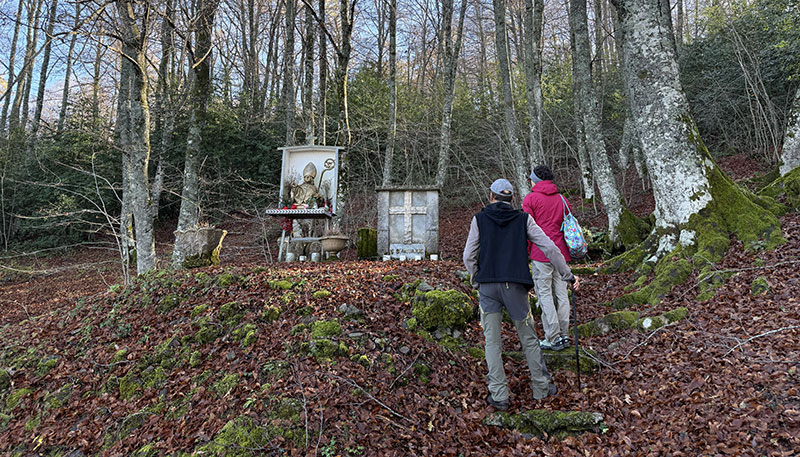
In the heart of the village stands the Mother Church of Santa Maria Maggiore (formerly known as S. Maria del Sorbaro), which probably already existed in the 13th century. Its façade features stone friezes and an imposing bronze door dedicated to the patron saint, St. Valentine, the work of the Lucanian sculptor Antonio Masini. The interior houses authentic artistic treasures: a large 17th-century canvas by Pietrafesa entitled 'La Vergine consegna la pianeta a Sant'Aldefonso' (The Virgin delivers the chasuble to St. Alphonsus), a holy water font supported by a sculpted hand and, in the right transept, the bust of St. Valentine with his relics. A niche also houses the precious wooden statue of the Madonna di Monteforte, dating back to the end of the 13th century. Also not to be missed is the 16th-century church of San Gerardo, which preserves splendid frescoes by the Todisco brothers, the Church of SS. Annunziata, with its Paliotto, a refined 18th-century wooden inlay, and the Baronial Palace, the ancient residence of noble families. A scenic route of about two kilometres leads to one of the places most loved by the people of Abriola: the Sanctuary of the Madonna di Monteforte, located at an altitude of 1300 metres. A destination for pilgrimages and the centre of local spirituality, the sanctuary is not only a religious building but also a place of identity, deeply linked to the rhythm of life in the village.

The highly venerated patron saint of Abriola, the cult of St. Valentine has its roots in a legend that is deeply felt by the population: it is said that, during a period of severe famine, the saint, passing through Abriola on his way to Puglia, managed to obtain carts of wheat by pawning his ring, thus saving the inhabitants from starvation. Every 14th February, the tradition comes to life in a festival that combines the sacred and the folkloric. After the religious celebration and the procession of the saint carried on the shoulders of the people through the streets of the village, the day continues around the large bonfires of dry broom branches, the fucanoj. Here, there are musical competitions with accordions, folk songs, tastings of typical dishes based on pasta, homemade sausages and local wine, enlivening the village until the last flame is extinguished.
The painters Giovanni and Girolamo Todisco, probably father and son, or at least relatives, were originally from Abriola. They emerged between the 16th and 17th centuries as sensitive interpreters of Lucanian identity, capable of recounting Basilicata: a land observed with attention, narrated through faces, landscapes and traditions that transformed art into a veritable cultural map of the Lucanian territory between the Renaissance and the Baroque periods.