

Grumento Nova
The "Little Pompeii" of Basilicata
In the heart of the Upper Val d'Agri, overlooking the intense blue of Lake Pertusillo and immersed in the protected landscape of the Lucanian Apennines Val d'Agri Lagonegrese National Park, lies Grumento Nova: a medieval village that, just a few kilometres from its centre, preserves one of the most important archaeological wonders of Southern Italy. Here lies the ancient Grumentum, nicknamed 'the little Pompeii of Basilicata' - a Roman city that witnessed the epic clash between Hannibal (with his elephants) and the legions of Rome - with its original urban layout, aqueduct, 1st-century BC theatre, temples, republican and imperial baths, and imposing amphitheatre. A short distance away is the large Lake Pertusillo, one of the most evocative bodies of water in Basilicata. Among chestnut and beech woods, you can go trekking, birdwatching, sport fishing and mountain biking. Also worth mentioning is the enchanting Bosco Maglie, home to the "Bosco dei Cigni" environmental centre.
When Saracen raids devastated Grumentum between the 9th and 11th centuries, the inhabitants found refuge higher up, on a hill overlooking the valley. This is how Saponara came into being, the medieval settlement that over time became the present-day Grumento Nova. The Normans enfeoffed it around 1060: the first lord was Roberto d'Altavilla, who built the castle and a solid wall. This was followed by the rule of important families, including the Sanseverino family, who marked its history until the 19th century. In 1857, a violent earthquake destroyed most of the town, which was then rebuilt. The name Grumento Nova was officially adopted in 1932.
Today's village retains its medieval character: a charming network of narrow streets, stately buildings and, above all, the remains of the Norman 'Sanseverino' Castle, which dominates the historic centre from above and takes its name from the Prince of Bisignano and Count of Saponara, Carlo Maria Sanseverino, who had it restored in the 18th century. It once had over 300 rooms: today, visitors can see an 18th-century hall decorated with angels and cherubs. The religious tradition of the village is evidenced by numerous churches, including the Mother Church of Sant'Antonio Martire, built in the 12th century on the remains of an ancient pagan temple, which contains 16th-century frescoes and a 19th-century coffered ceiling; the Church of the Rosary, notable for its wooden altar frontal of the Neapolitan school and its polychrome altar; the Chapel of San Infantino, built by Basilian monks in the year 1000, which preserves medieval frescoes of Saints Cosmas and Damian; and the churches of San Rocco, Madonna della Clemenza and Santa Caterina.
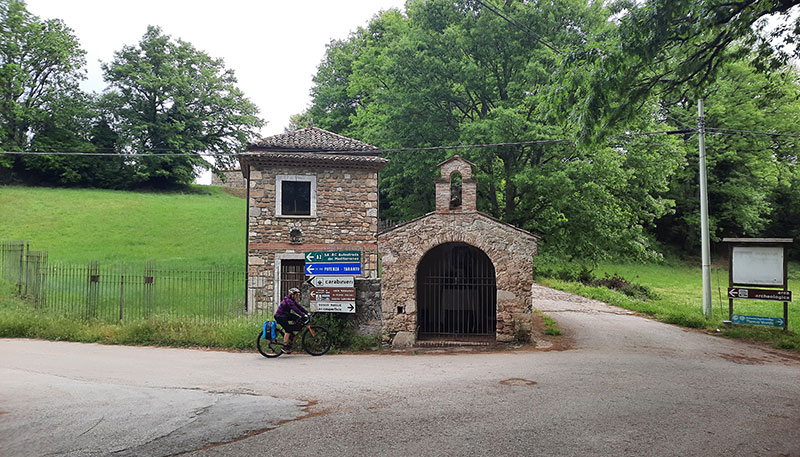
Near the ancient Roman city of Grumentum, where a female deity linked to the goddess Mefitis was once worshipped, stands the Sanctuary of the Madonna del Grumentino (Salus Infirmorum), which houses a precious 15th-century statue of the Madonna and Child, dressed in a red tunic with a golden belt and a blue cloak decorated with golden stars, an object of great devotion. In fact, every year, on Low Sunday, a striking procession takes place from the Mother Church to the sanctuary, followed by the traditional fair and an outdoor lunch.
Furthermore, within the Archaeological Park, in the northern part of the Roman settlement, along the main road, stands the Basilica of Santa Maria Assunta, which was most likely the first cathedral of the Grumentina bishopric, attested with certainty between the end of the 4th and 5th centuries AD It is mentioned in a letter from Pope Gregory the Great as 'parochiae ecclesiae Grumentinae'. The original building reflected a monumental layout of clear early Christian origin, which was never completely abandoned. Particularly striking are the medieval frescoes, fragments of a pictorial cycle dating from between the 13th and 14th centuries, when the church was still active: among these, the delicate face of a saint in prayer stands out, testimony to a devotion that has spanned the centuries.
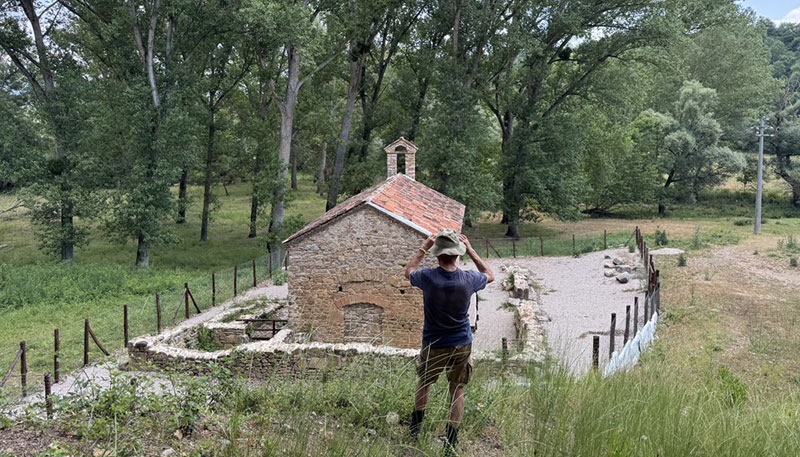
With regard to the Grumentum Archaeological Park, few sites in Italy allow such a clear view of the urban structure of an abandoned Roman city that was never rebuilt. Among the must-see attractions are: the Roman Theatre, built in the Julio-Claudian era, a perfect example of Roman theatre architecture, which today hosts events such as the 'Teatri di Pietra' festival; the Domus dei mosaici, a large private residence that offers a privileged insight into the life of the Roman elite; the Republican Baths, which, with their apodyterium, frigidarium, tepidarium and calidarium, recount the wellness rituals of ancient Grumentum; the Forum, the beating heart of public life with temples, porticoes, a basilica and a perfectly legible urban layout; the Imperial Baths, among the best-preserved bath complexes in the world, famous for their extraordinary marine mosaic featuring Scylla, giants and aquatic creatures. Hellenistic statues of nymphs, Dionysus and Aphrodite in Parian marble have also been found. Finally, the Amphitheatre, built in the 1st century BC, was a venue for public games that attracted spectators from all over the Val d'Agri.
To complete the experience, the National Archaeological Museum of the Upper Val d'Agri - one of the richest in southern Italy - houses finds from Grumentum and recent excavations. Among the exhibitions, those dedicated to the Roman villa of the Bruttii Praesentes stand out. This residence, located in Barricelle di Marsicovetere and linked to the family of Brutia Crispina, wife of Emperor Commodus, represents one of the most significant archaeological discoveries of recent years.
Over the centuries, Grumento Nova has produced many outstanding minds, including:
Esara, who lived between the 6th and 5th centuries BC, was a Greek philosopher of the Pythagorean school, originally from Grumentum, and cited by Iamblichus as a prominent figure in ancient thought. Her philosophical reflection focuses on the nature of man and the rational foundations of social and political life. She is credited with the fragment περὶ φύσιος ἀνθρώπου ('on the soul of man'), which analyses the qualities of the human soul and their role in guiding moral and civic actions.
Amato Danio (Saponara, 1619 - Naples, 1705), a prominent Italian jurist of the 17th century who held prestigious positions as judge of the Grand Court of the Vicariate and royal counsellor. In addition to his legal work, he devoted himself passionately to classical studies and the history of Lucania, and among his most significant works is the Italian translation of Strabo's Geography of Ancient Lucania.
Aurora Sanseverino (Saponara, 1669 - Piedimonte Matese, 1726) was one of the most influential noblewomen, poets and patrons of the arts in the Kingdom of Naples. The daughter of Carlo Maria Sanseverino and Maria Fardella, she supported artists and musicians such as Giacomo Antonio Perti, Anna Sarti, Luca Giordano, Francesco Solimena and Paolo De Matteis. Enrolled in the Accademia dell'Arcadia under the name Lucinda Coritesia, she actively participated in numerous Italian academies and hosted theatrical performances in her palace, including works by Handel, Alessandro Scarlatti and Niccolò Giuvo.
Francesco Pricolo (Saponara, 1891 - Rome, 1980) was one of the leading figures in 20th-century Italian aviation. A designated general of the Regia Aeronautica (Royal Air Force), he held high-profile positions, including undersecretary at the Ministry of Aeronautics and chief of staff of the Air Force.
Grumento Nova presents itself as a place of the soul, where every era has left a recognisable mark. It is a territory that has been able to embrace change without losing its identity, preserving a long and deeply shared history in its stone, landscape and memory.