

Castelsaraceno
Where the two parks meet
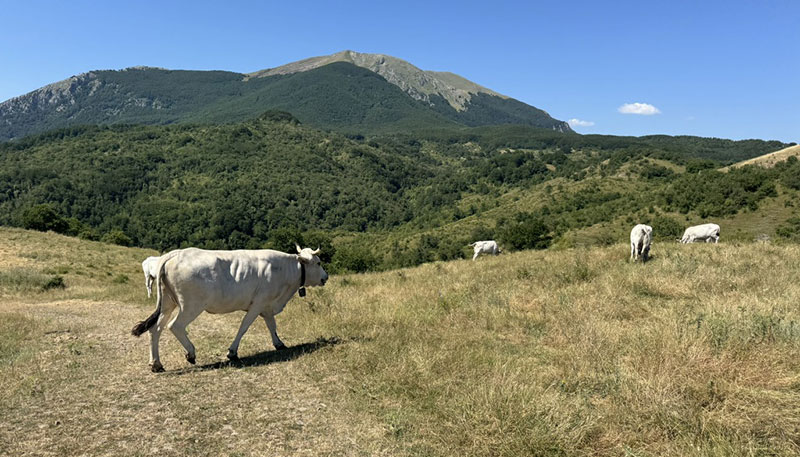
Nestled between the Lucanian Apennines and Pollino mountains, Castelsaraceno is a village that lives in perfect harmony with nature and tranquillity. Here, where the air smells of woods and the peaks seem to touch the sky, the landscape opens up in an embrace of rocky spires, deep valleys and forests that change colour with each season. To the south, the severe silhouette of Monte Alpi (1900 m) stands out, with its vertical cliffs and the rare Loricato pine, the millennial guardian of Pollino. To the north, Monte Raparo (1764 m) watches over the village with its barren ridges, shaped by time and glaciation. All around, immense forests accompany visitors in a landscape that invites them to walk, breathe slowly and contemplate. Natural springs add a fresh and ancient note, recalling the intimate connection between these places and water and earth.
The very name Castelsaraceno, Castrum Saracenum, reveals its past as a Saracen fortification built in 1031 near the ancient settlement of Planura. The ancient settlement, destroyed by an earthquake, was abandoned for centuries until the Basilian monks of the Abbey of Sant'Angelo al Raparo brought it back to life. Since then, the village has grown around the Tempa rock, in a maze of narrow alleys, stairways and perched houses. Walking towards the upper part of the village, you will come across the remains of the walls and a 10th-century quadrangular tower, a small fragment of a distant world. In the centre, the Baronial Palace, with its rusticated portal, recalls the presence of the Sanseverino family and the noble families who marked the history of the area.
Castelsaraceno preserves churches rich in history and works of art. The Mother Church of the Holy Spirit, dating back to between the 16th and 17th centuries, amazes with its triptych by the painter D'Amato and the polyptych by Ippolito Borghese. The Church of San Rocco houses a precious wooden statue of the Blessed Stefano Seno, while the Church of Sant'Antonio has a Baroque altar and an evocative wooden Christ.
To truly understand the soul of the area, the Museum of Sheep Farming is a must-see. It is not just a museum, but an experiential journey that recounts the life of shepherds, the seasons of the mountains, the knowledge handed down and the gestures of the past. Multimedia environments, 'talking' objects, immersive videos and real testimonies guide visitors through a story of lit fireplaces, flocks on the move, rough hands and timeless landscapes.
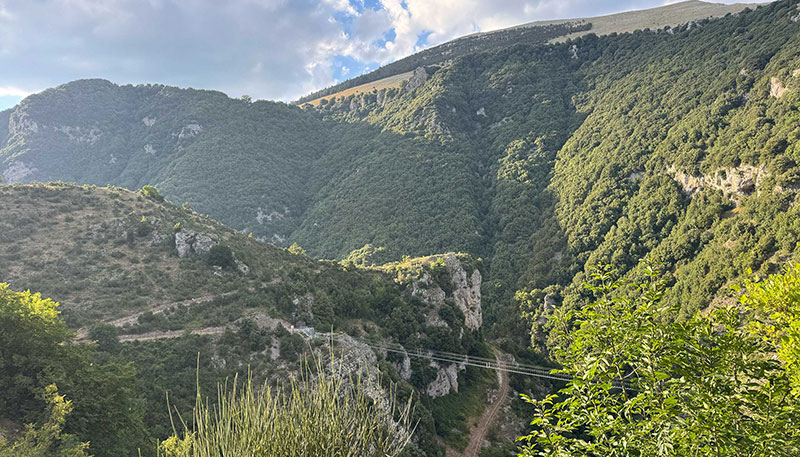
For those who love adventure, don't miss the experience of walking another 1,160 steps on the longest Tibetan bridge in the world: a 586-metre structure suspended 80 metres above the ground, connecting the Pollino National Park to the Lucanian Apennines Val d'Agri Lagonegrese National Park.
Every year in June, Castelsaraceno becomes the setting for one of the most evocative rituals in Basilicata: the centuries-old Festa della 'Ndenna, the marriage between trees, a collective ritual that unites the sacred and tradition, community and mountains. The tree in question, a large beech, is chosen in the woods of Favino and dragged into the village amid music, shouts and laughter. Its 'bride', the cunocchia, is cut down on Monte Armizzone. The ceremony, celebrated in front of the church of Sant'Antonio, culminates with the raising of the 'Ndenna, which stands majestically in the heart of the square as a symbol of rebirth and celebration.
The ritual continues until the Festa della Montagna (Mountain Festival), with excursions, trekking, horse riding, outdoor activities and convivial moments that transform the village into an open-air laboratory dedicated to nature.
Among the illustrious figures of Castelsaraceno, we remember Niccolò Piccinni (Castelsaraceno, 1704 - Naples, 1768), a prominent jurist and poet of the 18th century, known for his versatility between law and literature. He wrote numerous poems but never created a complete collection of his works. He left a cultural legacy that combines legal rigour and literary sensitivity, making him one of the most significant figures of 18th-century Lucania.