

Carbone
The ancient village nestled between history, woods and silence
Nestled on the left bank of the Serrapotamo stream, Carbone is a small mountain village in the province of Potenza, straddling the Lucanian Apennines Val d'Agri Lagonegrese National Park and the Pollino National Park. Formerly known as Montedoro, probably due to the fertility of its land, the village retains an authentic soul made of stone, woods and memory. It is surrounded by extensive forests of beech, chestnut and silver fir, and a few kilometres from the centre is the Bosco Vaccarizzo, a site of Community importance, which preserves precious patches of ancient forest. Here, biodiversity finds ideal conditions thanks to a sparsely populated environment and the presence of dead wood and many hollow trees, which are essential for numerous species. The area is rich in springs, fountains and waterways, ideal for walks, excursions and moments of relaxation.
Historical information about this village prior to the 10th century is fragmentary. In Roman times, the area was inhabited by communities linked to the Osci, who were mainly engaged in sheep farming and, following their subjugation to Rome, shared its political and administrative fate. After the fall of the Empire, the territory came under the rule of the Lombards and later the Normans. It was around the year 1000 that the first reliable historical evidence emerged, linked to the foundation of the Basilian monastery of Saints Elia and Anastasio by monks - probably Saint Luke Abbot of Carbone, a Basilian monk venerated as a miracle worker - who came from the East and were fleeing iconoclastic persecution. The monastery played a central role in the economic development and management of the territory, also performing welfare and charitable functions and leaving a profound mark on the urban and agricultural structure. Its heyday was reached in the 12th century, when the monastery was recognised as an archimandrite, assuming the role of guiding centre for a vast network of Greek monasteries in southern Italy. Under the protection of sovereigns such as William II and Frederick II, the monastery enjoyed considerable autonomy and prestige. In the following centuries, however, isolation from the East and the decline of cultural exchanges marked the beginning of a slow decline, accentuated by fires, conflicts with feudal powers and the progressive reduction of the monastic community. Today, all that remains of the monastic complex are evocative ruins, which can be visited in Valle Cancello, bearing witness to a spiritual and industrious past.
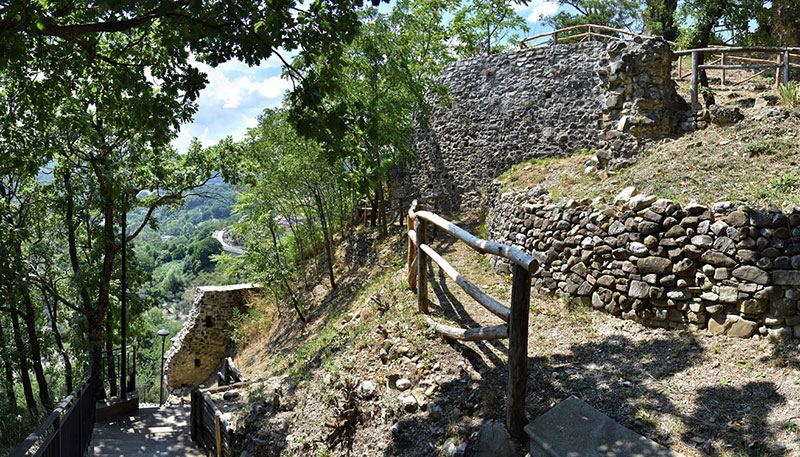
The ancient village has preserved much of its original urban layout, with characteristic arches connecting several houses and narrow, charming alleys (strectule or diverticula) that run through the village like vital, pulsating arteries. Strolling through its streets, you will come across noble palaces such as Palazzo Castello, Palazzo De Nigris and Palazzo Castronuovo, elegant stone portals, houses and alleys that tell the long history of this mountain community.
Also noteworthy is the Mother Church of San Luca Abate (16th century), built on an older structure, which houses a rich heritage of works of art, sacred furnishings and relics that bear witness to the deep historical and spiritual link with the ancient Monastery of Saints Elia and Anastasio, from which numerous artefacts of particular devotional and symbolic value originate. Among the oldest elements preserved in the building are the two sandstone holy water fonts, dated 1559 and 1581 respectively, while of particular note is the altar dedicated to Saint Elias, patron saint of Carbone, with a painting depicting the prophet on the chariot of fire, a work from the late 16th or early 17th century, perhaps attributable to Bernardino Cesari. Next to it, the fresco of the Dormitio Virginis, which re-emerged during the 20th-century restoration, explicitly refers to the Eastern tradition and Greek spirituality, closely connected to the monastery of Saint Elias, as do the wooden statue of Saint Mary of Egypt and, above all, the precious gilded reliquary box placed under the altar dedicated to her, containing the relics of the Eastern hermit saint. Also of great importance is the reliquary bust of Saint John the Almsgiver, Patriarch of Alexandria, preserved in a niche in the presbytery. Already documented in the Platea of 1741 and in subsequent inventories as coming from the monastery church, the reliquary - with a silver head and gilded bronze bust - is one of the most evident signs of the privileged relationship between Carbone and the Christian East, consistent with the Italo-Greek origins of the monastery. The wooden statue of Saint Luke the Abbot, patron saint of the church, located in one of the niches next to the high altar, is also linked to the monastic sphere. The 18th-century work, although retouched, conveys the solemn image of the founding abbot and refers directly to the spiritual tradition of the monastery of Sant'Elia, of which Saint Luke was a central figure.
Alongside these monastic artefacts, the church preserves works from later periods that enrich the devotional heritage of the community, such as the statue of Saint Donatus the Bishop, the Madonna del Carmine with souls in purgatory, the Holy Family by Francesco Oliva, the 20th-century Addolorata and the modern statues of Saint Joseph and the dead Christ.
Taken together, the works and relics of the church of San Luca Abate constitute a veritable repository of the historical and spiritual memory of the monastery of Saints Elia and Anastasio, handing down its central role in the religious, cultural and identity formation of the community of Carbone.
Among the other symbolic places of this charming village, the Church of the Annunciation and the former Convent of San Francesco (16th century) undoubtedly stand out. . The church houses an artistic heritage of great value. Among the most significant works are the Porziuncola painted by Francesco Oliva, the statues of San Francesco and San Donato, patron saint of the village, the Marian paintings and, above all, the imposing wooden group of the Annunciation, a masterpiece of intense expressive power. Also noteworthy is the chapel dedicated to St. Francis of Assisi, added in the late 18th century, which houses the famous wooden statue of the saint: a powerful work full of pathos, in which Francis, marked by the stigmata, reaches out towards the Crucifix in a silent dialogue of compassion and faith.
The Church of the Annunciation remains a treasure trove of memory and beauty today, despite earthquakes, suppressions and 19th-century transformations that have unfortunately destroyed part of the original altars and decorations. Visiting it means taking a journey through art, Franciscan spirituality and local history.