

Calvello
A village nestled between mountains and ancient streets
Perched on the left bank of the La Terra river, a tributary of the Camastra, and surrounded by the mountains of the Lucanian Apennines, Calvello still retains the atmosphere of an ancient noble fiefdom. The medieval village is spread out among steep alleys, stone houses leaning against each other and small squares that open up suddenly, offering picturesque views of the dense woods that surround it. The peaks of Monte Viggiano, Monte Rotunno and, above all, Monte Volturino (1,836 m) offer sweeping views that, on clear days, extend to the Basento and Agri valleys, almost touching the Ionian Sea. The area, which is part of the Lucanian Apennines Val d'Agri Lagonegrese National Park, is also ideal for winter sports enthusiasts, thanks to the Volturino ski resort.
Calvello has ancient origins: while the first settlements may date back to the Lucanians, the very name of the village - perhaps derived from the Latin caro et vellus ('meat and wool') - bears witness to the Roman presence. The village developed around two centres: the castle with the noble church of San Nicola and, downstream, the monastery of Santa Maria De Plano. The medieval castle, built on the remains of a Lombard fortification and belonging to various noble families over time, dominates the village. It was a strategic point of defence for the upper Val d'Agri against Arab incursions. The location was already important in Roman times, thanks to the intersection of important communication routes between the Basento and Agri valleys. In medieval times, the site became part of a network of fortresses - together with Abriola, Brindisi di Montagna and Anzi - capable of exchanging signals at a distance with fires and smoke. The Church of San Nicola, an ancient noble chapel built next to the castle and linked for centuries to the history of noble families, still preserves the evocative 'prince's box', a small wooden gallery from the Ruffo era from which the lords attended services. The high altar houses an elegant 16th-century polyptych attributed to the painter Stefano Sparano da Caiazzo.
Calvello boasts a rich architectural, cultural and religious heritage: the Mother Church of St. John the Baptist (15th century), with works from the Neapolitan and Florentine schools, including the precious canvas depicting the Madonna of Constantinople (16th century); the Church of Santa Maria degli Angeli, embellished with frescoes dated 1616 and signed by Girolamo Todisco from Abriola; the Church of Santa Maria del Piano (12th century), one of the most significant sacred buildings in the region, which houses a valuable wooden choir, a pipe organ (16th century) and the precious gilded wooden statue of Santa Maria del Piano, dating from between 1240 and 1260, which is one of the most significant Marian works in the area. Also of considerable interest is the cloister with barrel vaults frescoed by an unknown artist depicting scenes from the lives of St. Anthony and St. Francis.
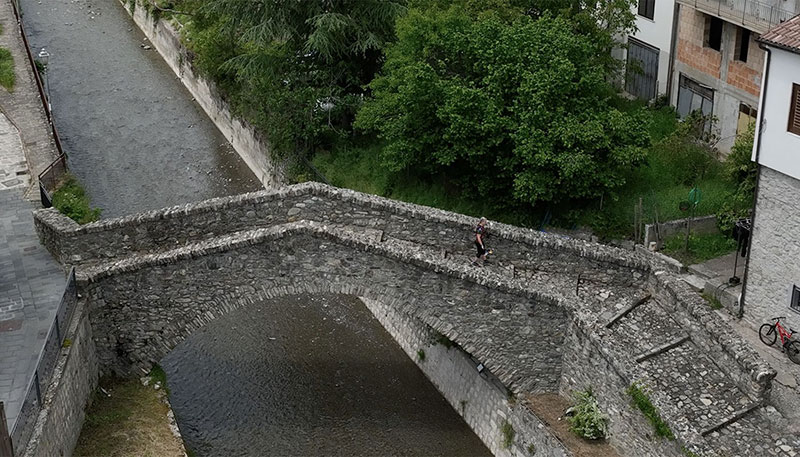
In addition to the castle, another emblematic site in the village is the medieval bridge of Sant'Antonio over the La Terra stream, a 14th-century structure with a single lowered arch built by the Benedictines - probably on pre-existing Roman structures - to connect two districts.
Another place particularly dear to the people of Calvelli is the Sanctuary of Maria Santissima del Monte Saraceno, located at an altitude of about 1320 metres on a rocky spur at the foot of Monte Volturino, from which there is an extraordinary view of the valley. Legend has it that the sanctuary was built near the cave once inhabited by a hermit. Founded around 1150 by Benedictine monks, the building has undergone several restorations over time. Inside is the Sacred Effigy of the Madonna del Monte Saraceno, enclosed in a small temple called a "caggia" (display case). The sanctuary is the destination of one of the most heartfelt processions in Basilicata: on the second Sunday in May, the statue is carried from the parish church to the sanctuary, while on 8 and 9 September it returns to the village. It is traditional for pilgrims to walk three times around the building, singing ancient Benedictine chants, before entering the sacred place.
An architectural complex of considerable historical and religious importance is the Cenobio di San Pietro di Cellaria, built by the Congregation of Santa Maria di Pulsano sul Gargano (founded by St. Giovanni da Matera in 1128). and located about 6 km from the village at an altitude of 830 m, on the edge of a plateau bordered by a sheep track that followed the route towards the Val d'Agri, in the direction of Viggiano and then the Via Herculia. The dependence of the monastery of Calvello on the Abbey of Pulsano is attested in a document from 1177: 'monasterium Sancti Petri de Cellaria, quod situm est in territorio castri Calvelli ... cum pertinentiis suis' and is confirmed in a diploma of Frederick II from 1225, in which the monastery appears to be endowed with appurtenances, churches and rights. The Pulsanese settlement in Calvello with the erection of the monastery - the only appurtenance of the congregation in Basilicata - was designed for reasons that intertwined hermitic vocation, economic dynamics and popular devotion linked to the continuous movements of transhumance. The splendour of the monastery of St. Peter lasted about 150 years. At the end of the 14th century, the Mother House of St. Mary of Pulsano was entrusted to a commendatory abbot, and the monastery of St. Peter suffered the same fate, being ceded in 1587 by Pope Gregory XIII to the Sistine Chapel in Rome. The cycle of frescoes decorating the interior of the church (the only remaining evidence of the medieval monastic complex) and a series of annexes attached to the building are attributed to later periods, between the 17th and 18th centuries. In 1927, the complex was sold to private individuals, marking the beginning of its decline.
Calvello is also known for its production of artistic ceramics, a tradition that is still alive in the village's workshops. The decorative motifs reflect the local environment, with its green woods and yellow fields, featuring the image of a rooster, a typical iconography of Calvello ceramics. The barrels and flasks made by the barilai ('varricchiari') and the plates made by the scotellari ('scut'dari') are famous.
Among the most prestigious figures, Calvello counts Antonio Masini (Calvello, 1933 - Potenza, 2018), painter, engraver and sculptor, one of the most significant figures in contemporary Lucanian art. His works are now present in museums and collections around the world. With Antonio Masini, Basilicata produced an artist capable of transforming local history into a universal message, leaving a lasting mark on the contemporary cultural landscape.
Calvello was also the birthplace of one of the most promising and almost forgotten Italian chemists of the second half of the 19th century, Francesco Mauro (Calvello, 1850 – Naples, 1893), who died prematurely in circumstances that have never been fully clarified. He was mentored by Stanislao Cannizzaro, one of the fathers of modern chemistry, and became a full professor of Docimastic Chemistry, then director of the School of Application for Engineers in Naples, as well as a corresponding member of the Accademia dei Lincei. He contributed to the study of drinking and thermal waters and distinguished himself for his pioneering studies on the chemistry of materials, especially molybdenum. His burial in the enclosure for illustrious men in the Poggioreale Cemetery testifies to the lasting recognition of his scientific and human value.