

Brienza
A blend of history, religion and civic memory
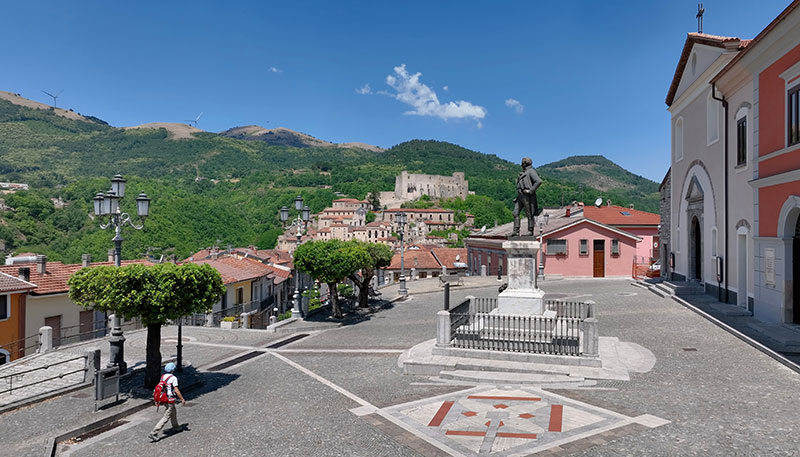
Brienza is a village with ancient charm, nestled in the Melandro valley and dominated by the imposing profile of Caracciolo Castle, one of the most symbolic medieval fortresses in Basilicata. The village is set in a natural environment of great beauty, with magnificent woods of centuries-old oaks, downy oaks, chestnut and beech trees, clear streams and gentle hills framing the historic centre, creating a landscape that alternates between tranquil atmospheres and surprising panoramic views. From the terraces of the village, the view stretches across the valley floor and the mountains of the Lucanian Apennines, offering a view that changes with the seasons and makes Brienza one of the most evocative places in the entire area.
Its roots date back to the Middle Ages, when the urban centre developed around the fortress, giving rise to a town rich in alleys, arches and panoramic views that still today tell centuries of history.
The village is home to numerous churches and places of worship that bear witness to a deep religious tradition. Among these, the Mother Church of the Assumption stands out, located in the heart of the historic centre, which preserves valuable works of art and a cosy atmosphere. No less important is the Church of San Cataldo, particularly dear to the community for its essential forms and the presence of the miraculous crucifix, the object of intense popular devotion. On the road that runs alongside the village stands the complex of Santa Maria degli Angeli, consisting of the Lazzaretto, used for civic functions, and two noble funeral chapels, and the precious 17th-century Church of Santa Maria degli Angeli, one of the most fascinating places in Brienza's artistic heritage. The interior of the church is distinguished by its coffered ceiling, which is still largely intact, and by the frescoes in the votive chapel by one of the most important interpreters of sacred iconography in 17th-century Lucania: Giovanni De Gregorio, known as Il Pietrafesa, depicting episodes from the lives of St. Francis of Assisi and St. Anthony of Padua, and a figurative cycle inspired by the Old and New Testaments, with scenes dedicated to the Virgin Mary.
The building of the ancient Lazzaretto now houses the MuLabo, the Museum Laboratory of Arts and Landscape, which promotes and recounts the territory through exhibitions and multimedia displays, cultural activities, workshops and seminars, which have led to the Mulabo being named a CEAS - Centre for Environmental Education and Sustainability.
For centuries, Caracciolo Castle has watched over Brienza, observing the life of the village from above. Its structure, dating back to the Norman era and enlarged several times in subsequent centuries, still preserves towers, courtyards and rooms that tell the story of noble families, sieges and architectural transformations. The fortress is shrouded in numerous folk tales: for example, there are stories of underground passages once used to connect the castle to the lower village, or of ancient figures who watched over the walls on stormy nights.
An interesting fact concerns the Pergola stream, which, together with the Fiumicello, flows on the edge of the village. Over the millennia, the water has shaped its rocky bed to create large natural basins where the water collects, giving rise to striking formations considered true natural monuments: the giants' pots, called 'R T'nedd' in the local dialect, from 'tnedde', the vats once used to store water or wine.
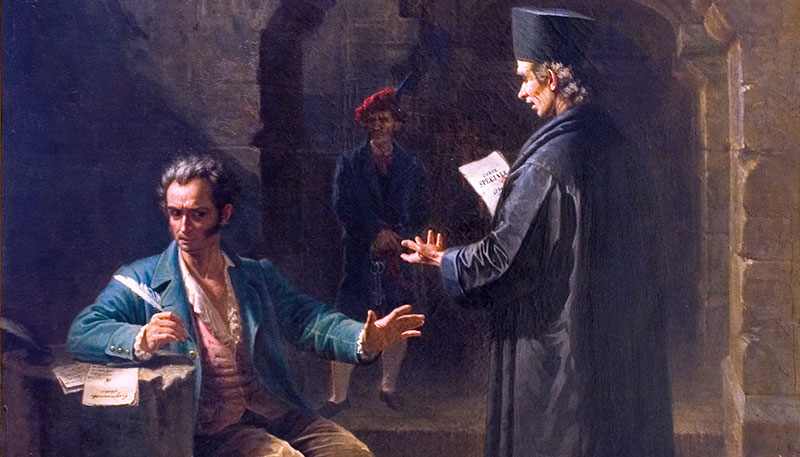
Brienza is the birthplace of the jurist, philosopher, playwright and politician Francesco Mario Pagano (Brienza, 1748 - Naples, 1799), martyr of the Neapolitan Republic and one of the leading exponents of the Italian Enlightenment, as well as a precursor of positivism. His cultural legacy is still celebrated today by the village, which dedicates museum spaces and commemorative initiatives to him.
But this town was also the birthplace of the doctor, psychiatrist and politician Luigi Ferrarese (Brienza, 1795 – Naples, 1855), one of the main proponents of phrenology in Italy and a precursor of criminal anthropology. He joined important Italian and European scientific academies and published works that made him famous, including Memorie risguardanti la dottrina frenologica (Memoirs on the Doctrine of Phrenology). He was one of the most original and controversial figures in 19th-century Lucanian scientific culture.
In this intertwining of history, religion and civil memory, Brienza retains a strong and recognisable identity, immersed in the evocative landscape of the Lucanian Apennines Val d'Agri Lagonegrese National Park.