

Laurenzana
The village carved into the rock
Nestled on three ridges that run through the Lucanian Apennine mountains, Laurenzana appears as a village suspended between history and nature. The Castle and the Mother Church dominate the town from above, while the houses stretch along the sides of the cliff, gently following the morphology of the landscape. Its position, straddling the pass that connects the Basento valley to the Val d'Agri, has given this town a strategic role over the centuries. Much of the territory is included in the Lucanian Apennines Val d'Agri Lagonegrese National Park, an environment that alternates between wooded ridges, deep valleys and peaks such as Mount Caperrino (1456 m).
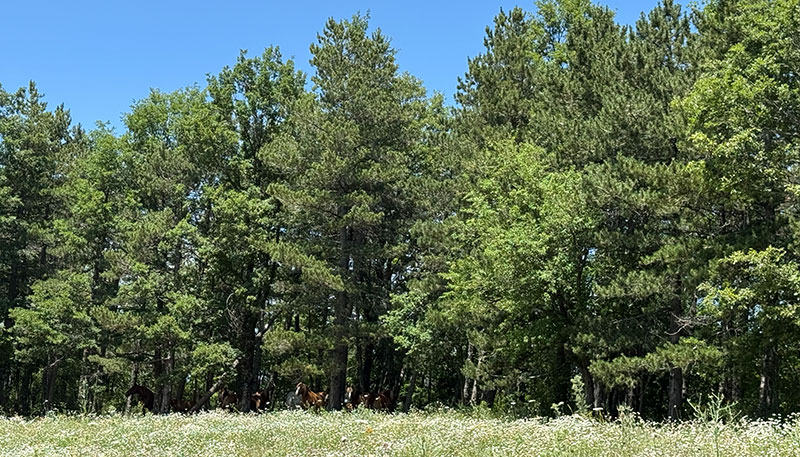
Not far from the town, the magnificent Abetina Regional Nature Reserve encompasses an unspoilt natural area that is unique in southern Italy: a rare example of a mixed forest of beech and turkey oak trees with native silver fir, a relict species of the southern Apennines that has survived thanks to the special microclimatic conditions of the area. The Reserve is one of the best-preserved forests in the region, with ancient and senescent trees that tell centuries of natural and human history, some of which are included in the list of monumental trees of Italy. Next to it lies the Foresta della Lata, a vast state-owned forest, home to oak woods, tall turkey oak woods, beech woods and precious fir woods, which tells a complex story of exploitation, protection and rebirth. Acquired by the state at the beginning of the 20th century to guarantee timber reserves and modern forest management, today it is the heritage of the Basilicata Region.
Among the monumental trees found in the Laurenzana area, a prominent place is occupied by the Oak of Fra' Egidio, a monumental oak belonging to the 'roverella' group, dedicated to the blessed Egidio, the Franciscan friar who, according to tradition, retired in prayer under this Father Tree. A symbol of the community itself, it is over 20 metres high, eight metres in circumference and estimated to be between 450 and 700 years old, undoubtedly one of the most majestic oaks on the peninsula.
The origins of the medieval nucleus are linked to the defensive needs of the time, when the first settlement developed around the cliff. Over time, the village grew around the two symbolic centres: the Castle and the Mother Church. The first documentary evidence dates back to the Norman period, followed by the Angevins, who redesigned both the fortress and the town, surrounding it with a new wall structure with round towers. In 1268, Laurenzana took part in the Ghibelline revolt and, in the following centuries, came under the rule of the Orsini del Balzo, Loffredo, Filangieri and finally Quarti di Belgioioso families. It was only in the 17th century, with urban expansion and increased trade, that the ancient towers were incorporated into the civil fabric and the village began to spread along the ridge, where bourgeois palaces such as Palazzo Graziadei-Domenico dell'Orco and Palazzo D'Urso were built.
Walking through the 'strèttele', the medieval streets that criss-cross the historic centre, you will discover picturesque views, arched underpasses and ancient stone houses. The imposing presence of the castle, perched on top of the cliff, watches over everything. Built in the 12th century by the Normans on a previous Lombard and Basilian settlement, it was renovated several times: by the Swabians, the Angevins and then the Aragonese. The arrival of the Orsini Del Balzo family in the 15th century marked an important transformation, when the fortress was reconfigured into a baronial palace, with loggias and new rooms. In the following centuries, other noble families modified its appearance until the 18th century, when it took on its current appearance. Fascinating legends still surround the fortress, such as that of the mysterious 'half lady', a mysterious woman who is said to appear at a window on silent nights, showing only the upper part of her torso.
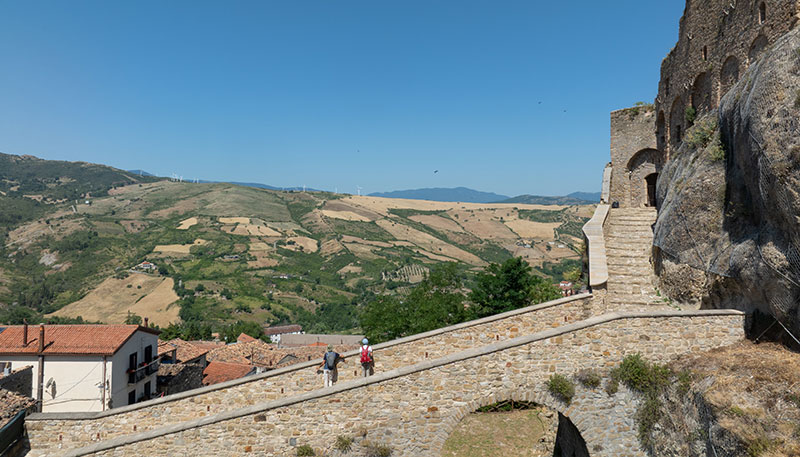
A few steps from the castle, the Mother Church of the Assumption stands on a large rocky spur. Built between 1214 and 1222 and consecrated to the cult of Santa Maria de Plateis, it was enlarged in the 16th century and extensively renovated in the 18th century, when the bell tower, the large presbytery and the spectacular oval staircase leading to the churchyard were added, and it was reconsecrated with the title of Santa Maria Assunta. Inside, it preserves a rich artistic heritage: wooden ceilings, inlaid cabinets, frescoes attributed to Colonna, paintings from the Lucanian school, an altarpiece with Christ Blessing and precious works on display in the Cappellone del SS. Sacramento. Another fascinating spiritual presence is the Church of Santa Maria ad Nives, surrounded by greenery and still home to ancient 16th-century frescoes.
A centre of faith and devotion deeply rooted in the history of the community is the Sanctuary of the Madonna del Carmine (16th-17th century), located along Corso Cavour in the heart of the village, which houses a rich artistic heritage: a high altar, a wooden choir from the Franciscan convent of Santa Maria della Neve, 19th-century paintings such as 'St John the Evangelist and Mary Magdalene at the Foot of the Cross' by Giovanni Zito, and an evocative 18th-century wooden crucifix, as well as a large canvas depicting the Madonna del Carmine with St John the Baptist and St John the Evangelist attributed to Cesare Scerra, and a precious wooden statue of the Virgin Mary from 1892 preserved in a carved display case.
Every year, on 16 July, the Madonna del Carmine is celebrated with a heartfelt procession through the streets of the town accompanied by singing, devotion and emotion. During the days of celebration, the 'Palio Carmelitano' also takes place, a historical re-enactment in which the four districts - Santa Filomena, San Michele, San Giacomo and San Giorgio - compete in games that recall medieval rivalries. The lily offered by the winners to the Virgin Mary becomes a symbol of belonging and unity.