

Lagonegro
The path of faith in the silence of the mountains
Lagonegro lies at the foot of Mount Sirino, in a landscape where the imposing profiles of the Apennines open up to the west towards nearby Maratea, the 'Pearl of the Tyrrhenian Sea', with its succession of cliffs, inlets, sea caves and beaches lapped by crystal-clear waters under the gaze of Christ the Redeemer, who dominates from the heights of Mount San Biagio. At an altitude of over 1,500 metres, Lake Laudemio, the southernmost glacial lake in Europe, shines brightly, taking on emerald green hues in spring thanks to the presence of a particular type of algae.
This corner suspended between forests, peaks and crystal clear waters is part of the Lucanian Apennines Val d'Agri Lagonegrese National Park and offers scenery that changes with the seasons, from the whiteness of winter to the cool shadows of summer. The Monte Sirino ski resort offers downhill and cross-country skiing slopes with scenery reaching two thousand metres, attracting skiers and snow sports enthusiasts, while in other seasons it becomes a paradise for trekking, Nordic walking, horse riding and cycling for experienced cyclists.
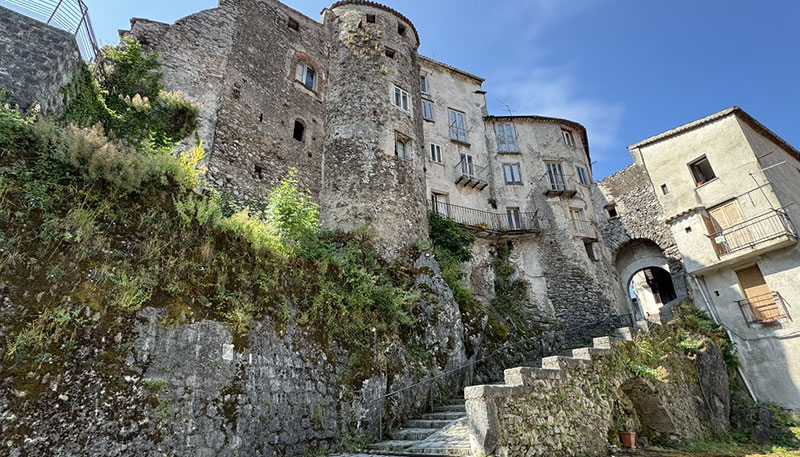
The history of Lagonegro has its roots in the 9th century, when Basilian monks founded the first settlement and the Convent of San Filippo, giving rise to a nucleus that in the following centuries would be fortified with walls and towers, of which evocative traces remain, such as the 'Porta di Ferro' (Iron Gate). Through this ancient gateway, you enter the medieval heart of the village, where a 17th-century staircase leads to the ruins of the castle and the Romanesque Church of San Nicola di Bari, where tradition has it that Lisa del Giocondo, the woman immortalised by Leonardo da Vinci in his portrait of the Mona Lisa, was buried in 1506.
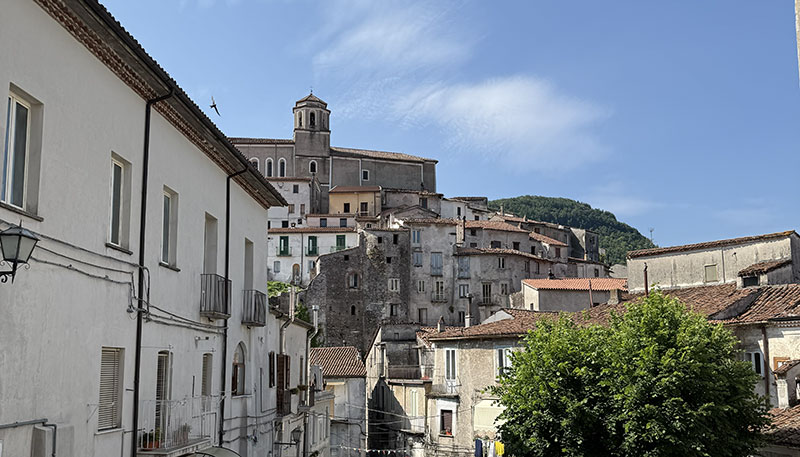
Next to the ancient village, with its steep alleys and houses built against the rock, lies the more modern part with its large square, Palazzo Corrado, the Parish Church of the Trinity, which houses the Madonna del Sirino during the winter, the Church of the Madonna del Rosario, which houses the Last Judgement (1824) by the Lagonegrese painter Antonio Cascini, and the churches of Sant'Anna, del Crocifisso and della Madonna delle Grazie, treasure troves of works spanning the centuries, including wooden sculptures, 17th-century paintings and precious altars. Just outside the town centre, among alders, chestnut and beech trees, stands the Convent of Santa Maria degli Angeli, founded by Basilian monks.
Every year, in June and September, Monte Sirino becomes the scene of one of the most intense pilgrimages in Basilicata. The statue of the Madonna del Sirino is carried on the shoulders of the faithful from the Church of the Trinity to the Chapel of the Madonna del Sirino (or della Neve), a small stone temple at an altitude of 1908 m, commissioned by the priest Don Ascanio Grisolia, built in 1629 and erected as a Diocesan Sanctuary in 1991, which can be reached along a path through woods, rocks and wide panoramic views. Here, the sacred image remains throughout the summer, preserved in the silence of the peaks, before returning to the village with the same solemn procession. This ancient ritual intertwines faith and nature, creating a deep bond between the community and the mountain that overlooks it.
Lagonegro has given birth to several prominent figures in the cultural, legal, artistic and social spheres. Here are a few: Domenico Abatemarco (Lagonegro, 1795-1799 - Naples, 1872) was a magistrate, politician and patriot. After the unification of Italy in 1860, he was a councillor of state and member of the Court of Cassation; the painter Antonio Cascini (Lagonegro, 1792 - Lagonegro, 1854) worked mainly in the Lagonegro and Cilento areas, where several of his frescoes and oil paintings are preserved. His most famous work is the fresco of the Last Judgement (1824) in the Church of the Madonna del Rosario in Lagonegro, inspired by Michelangelo's masterpiece in the Sistine Chapel; the geographer, geologist and politician Giuseppe De Lorenzo (Lagonegro, 1871 - Naples, 1957) was a lecturer at the University of Naples. He also studied Indology and spread knowledge of Buddhism in Italy. He was a member of the Accademia Nazionale dei Lincei and the Geological Society of London. He studied and promoted the great 'masters of wisdom' of the West, including Plato, Dante, Leonardo, Shakespeare, Goethe, Schopenhauer, Leopardi and Nietzsche, producing thirty-two scientific and philosophical publications in just a few years; the poet Donata Doni, pseudonym of Santina Maccarrone (Lagonegro, 1913 - Rome 1972). In 1949, she won the Estate Pesarese National Prize with the poems Voce d'Amore and Già la vigna s'arrossa. Some of her collections were published posthumously, including Il fiore della gaggìa, with a preface by Diego Valeri, and Neve e mare.
And how can we forget Pino Mango (Lagonegro, 1954 - Policoro, 2014), a great singer-songwriter known for his vocal technique defined as 'semi-falsetto' and for a style that blends different musical languages, who passed away more than 10 years ago. Mango's voice, however, has not faded away: it has changed its tone and body, reborn today in Angelina, who has taken up his legacy and transformed it into a new song.