

Lauria
A crossroads of history, spirituality and Apennine landscapes
Nestled in one of the most evocative settings of the Lucanian Apennines Val d'Agri Lagonegrese Park, Lauria is a natural gateway between Basilicata and Calabria, a meeting point of landscapes, cultures and itineraries that connect the Tyrrhenian Sea to the Ionian Sea. The town dominates the Noce Valley and is surrounded by fascinating scenery, where the mountains of the Sirino massif, snow-capped in winter, create an imposing and ever-changing horizon that captivates visitors in every season.
Behind the town rise the peaks of the Sirino, with Monte Papa reaching an altitude of 2,500 metres, among extensive beech forests, high mountain clearings and the picturesque Lake Laudemio, a glacial lake nestled at over 1,500 metres. It is here that Lauria reveals its naturalistic and sporting vocation: in winter, the ski area attracts alpine and cross-country skiing enthusiasts, while in the milder seasons, the area becomes a paradise for hikers, cyclists and lovers of trekking, Nordic walking and horse riding. The trails wind through silent woods and panoramas that, on clear days, offer views as far as the Tyrrhenian Sea. The Lucanian Apennines reveal themselves here as a laboratory of biodiversity, where the presence of the Apennine wolf, birds of prey and numerous wildlife species coexists with a rich and diverse flora, offering visitors an immersive experience in the most authentic nature.
This environmental setting is home to an ancient history that dates back to the 10th century. Lauria probably began as a fortified settlement, developing thanks to the passage of Basilian monks from the East, who were responsible for the first forms of religious and territorial organisation. Over the centuries, the town saw the presence of Lombards, Normans and Saracens, until it became a fiefdom of important noble families such as the Angioni, Sanseverino, Borgia and Ulloa.
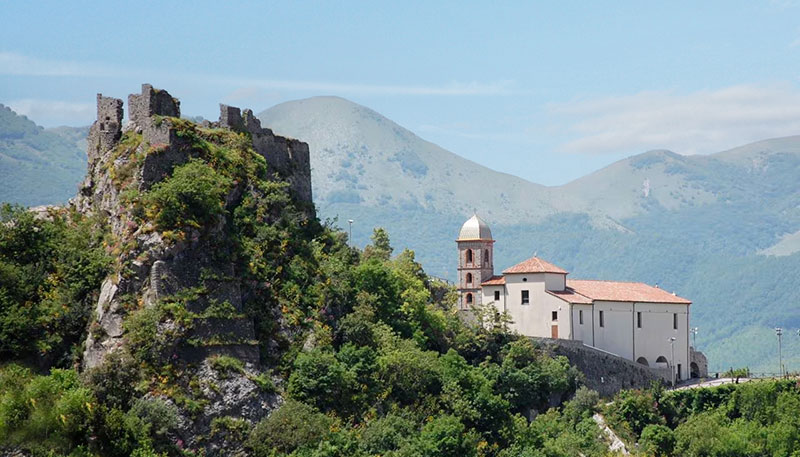
The original heart of the town was built around the Armo fortress, where the remains of Ruggero's Castle still stand today. This mighty fortification dominated the entire Noce Valley and was the scene of crucial historical events. The castle bears the name of its former owner Ruggero, Admiral of Sicily and Aragon, a figure who became famous for winning every battle he fought in and was therefore considered a military genius. Between the 16th and 17th centuries, Lauria maintained a leading role, enriching itself with convents, religious buildings and civil institutions, thanks in part to Cardinal Lorenzo Brancati. However, the 17th century also saw dramatic moments, such as the plague of 1655, which decimated the population. Between the 18th and 19th centuries, the town was involved in the turmoil of the Neapolitan Republic and suffered one of the most tragic episodes in local history with the French sacking of 1806.
Natural and war-related events, from the landslide of 1820 to the earthquake of 1980, have ultimately shaped the modern face of Lauria, without affecting its historical identity.
The town centre still retains a strong medieval layout and is divided into two historic districts: Lauria Superiore, known as the Castle, and Lauria Inferiore, the Village, separated by the ancient district of Ravita, a term that recalls the ancient Saracen presence. Strolling through the historic centre means immersing yourself in a maze of alleys, arches, stone portals, noble palaces and wrought iron railings, which tell the story of centuries of daily life and cultural stratification.
The religious heritage is one of the most distinctive features of Lauria, not only for the number and quality of its sacred buildings, but also for the works of art they house. A central figure is Blessed Domenico Lentini, patron saint of the city, whose spirituality has had a profound impact on the community. His relics are preserved in the Mother Church of San Nicola di Bari, in the upper part of the town, and his birthplace is a destination for pilgrimages. The church building, which has been remodelled several times over the centuries, houses a rich artistic heritage: 19th-century frescoes decorating the vault, paintings by southern artists, 18th-century wooden statues and a fine polychrome marble high altar. Of particular note is the altarpiece dedicated to Blessed Lentini, created in recent times, which testifies to the continuity of popular worship and devotion.
In the lower district is the Church of St James the Apostle, another religious and identity hub for the community. Inside, the magnificent carved wooden choir, dating from between the 16th and 17th centuries, from the Cistercian Monastery of Sagittario stands out: a work of extraordinary craftsmanship that represents one of the most important examples of sacred woodwork in the area.
In addition to its parish churches, Lauria boasts a number of important convent complexes. The Capuchin Convent of Sant'Antonio, founded in the 17th century, houses important paintings, including a polyptych attributed to Ippolito Borghese and 17th-century paintings of sacred subjects, as well as an evocative cloister that retains the atmosphere of monastic contemplation. The Immacolata complex, with its elegant porticoed cloister and Romanesque bell tower, is another fundamental part of the local architectural and religious heritage, housing frescoes and Baroque decorations.
In a dominant position overlooking the Noce Valley, between the two historic districts of San Nicola and San Giacomo, stands the Sanctuary of the Madonna dell'Armo, a place of profound devotion and great scenic beauty. Dedicated to the Virgin Mary, the building is recognisable by its solemn raised pronaos and has ancient origins: it stands on a Basilian laura (the place name 'Armo' most likely derives from the Greek word armos, which indicates a cavity or rocky ravine where monks used to retreat to live as hermits). Over the centuries, the building has undergone transformations and restorations, including following damage sustained during the French siege of 1806. The atrium, with round arches and a spectacular elliptical staircase, leads to a three-nave interior covered by barrel vaults. Of particular note is the Baroque altar, which houses a precious 14th-century wooden statue of the Virgin and Child on a throne, depicted with a blue globe in her hand and wrapped in a gold-embroidered cloak. The artistic heritage is enriched by 19th-century paintings, devotional statues and refined polychrome stained glass windows that narrate the religious history of the two districts and the profound Marian devotion of the place. Perched on the rock, the sanctuary combines sacredness and nature in a combination typical of places of worship in southern Italy, offering wide and silent views that reinforce the sense of spirituality of the place.
Lauria is the birthplace of actor and director Rocco Papaleo, who chose his homeland as a symbolic location for the film Basilicata Coast to Coast, helping to convey the authentic soul of these places to a wider audience.
With its nature, history and spirituality, Lauria offers visitors a place to be experienced slowly, capable of surprising them with the variety of its landscapes and the intensity of its identity, suspended between mountains, valleys and horizons that seem to have no boundaries.