

Marsico Nuovo
A place where the mountains tell tales of ancient civilisations
Marsico Nuovo lies on the western side of the upper Val d'Agri, at an altitude of 865 metres, in a position that embraces the Agri river valley and looks towards the border with the province of Salerno. The Fontana delle Brecce - Piana del Lago nature reserve offers a fascinating landscape with beech and turkey oak woods, fresh springs and seasonal streams. Further on is the Piana del Lago, a large plateau at the foot of Monte Lama, enlivened by a small natural reservoir fed by local springs. Its proximity to the Sellata ski slopes, Monte Volturino and various Sites of Community Interest makes this area a favourite destination for those seeking authentic nature, unspoilt scenery and a deep connection with the Lucanian landscape. From a naturalistic point of view, the following are also worth mentioning: an ancient monumental chestnut tree, almost 500 years old, which can be admired in Camporotondo, boasting a height of about 20 metres and a circumference of 7.5 metres; and one of the most surprising underground treasures of the Lucanian Apennines, the Castel di Lepre Cave, the longest underground system in Basilicata, almost two kilometres long and with a vertical shaft over 13 metres deep with waterfalls, clear pools, a long laminator and large galleries decorated with concretions that lead through several pools to a terminal lake.
The village has its roots in the ancient settlement of Abellinum Marsicum, founded by the Marsi between the 5th and 6th centuries BC at the foot of Mount Volturino. Over the centuries, Marsico Nuovo has played an important role: first as a bishop's seat, then as a Lombard stronghold linked to the principality of Salerno. Even today, the upper part of the village retains the layout of the ancient medieval village, the Civita, while the modern area extends further down, on the Portello and Casale hills. With the Normans, it became the administrative capital of a vast territory that included the Vallo di Diano and the lower Cilento, then power passed into the hands of great families such as the Sanseverino, the Carafa and the Counts of Marsico. When this family died out, the fiefdom returned to the royal domain and finally to the Pignatelli princes until the abolition of feudalism.
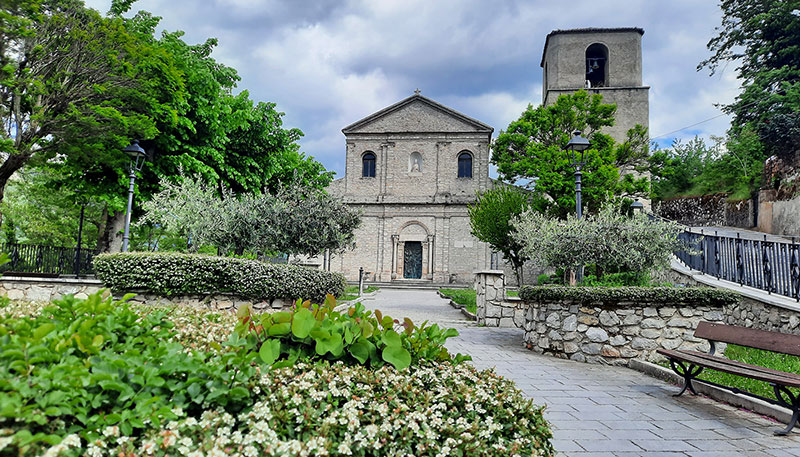
Strolling through the historic centre means walking through centuries of history: noble palaces such as the Pignatelli - now the Town Hall, featuring a well dating back to 1572 in the inner courtyard - and the Navarra - known for its majestic portal - bear witness to ancient splendours, while churches and sacred places such as San Gianuario and the Cathedral of San Giorgio Martire preserve memories of faith and tradition, as does the Church of the Madonna del Carmine, which houses a 14th-century wooden sculpture depicting the Madonna and Child, attributed to Giovanni da Nola. Of particular importance is the Church of San Michele Arcangelo, which houses the Museum of Sacred Art, home to works such as the fresco of The Last Supper by Girolamo Todisco (16th century), depicting Christ and the apostles around a table laden with local products such as caciocavallo cheese, surmounted by a ceiling painted on wood in 1737. Just outside the town, immersed in the silence of nature, stands the Sanctuary of the Madonna di Costantinopoli (or del Ponte), an important centre of worship and pilgrimage, built in the second half of the 16th century on the site of a pre-existing chapel, which houses a wooden statue of the Madonna and Child, probably dating back to the 17th century.

In the heart of the village stands one of the most fascinating monumental complexes in the area: the ancient building that now houses the administrative headquarters of the Ente Parco Nazionale dell'Appennino Lucano Val d'Agri Lagonegrese (Lucanian Apennines Val d'Agri Lagonegrese National Park Authority). This imposing medieval palace, known as Palazzo Manzoni, has its roots in 1179, when Guglielmo III Guarna had it built as an Augustinian monastery. About a century later, Count Ruggero Sanseverino transformed it into a Benedictine convent, which also welcomed Saint Agnes of Aquino, niece of Saint Thomas, who was the abbess. In 1875, the structure became the headquarters of the 'Alessandro Manzoni' schools. The monumental complex, which covers about seven thousand square metres of courtyards, paths and ancient stone structures, still retains the evocative grandeur of the past. Every summer, the 'Walk through History' event takes place here, commemorating St Thomas Aquinas' visit to his sister Theodora, wife of Count Sanseverino, which took place around the 13th century.
The figure most loved by the Marsicans is certainly Saint Januarius, one of the few saints celebrated three times a year. Sources say that he was a bishop of Carthage sent to Lucania in 347 to combat paganism. He died in an ambush in the Arioso forest and was buried at the site of his martyrdom. In 1045, thanks to a revelatory dream by a local woman, his body was found and became an object of veneration. Depictions of the saint often show him holding a book, symbolising his evangelising mission. The Sanctuary of San Gianuario houses the bust of Saint Stephen, attributed to the school of the master Melchiorre da Montalbano, the wooden bust of San Gianuario made by Giacomo Colombo in the 18th century, 17th- and 18th-century paintings, a 14th-century wooden Madonna and a medieval fresco from the Church of San Francesco. The modern bronze door by Antonio Masini narrates the life of the saint. An ancient yoke preserved in the sanctuary recalls the episode in which the saint's body, after his martyrdom, was placed on a cart pulled by two oxen left to roam free: the animals stopped right where the abbey was built.
Among the important figures born in Marsico Nuovo is Antonio Lotierzo (Marsico Nuovo, 1950), poet, writer and essayist. He is the author of several historical monographs on some towns in Basilicata. He has received important awards, including the Alfonso Gatto Prize (1992), the Eugenio Montale International Prize for unpublished works (1994) and the Pierro Prize for poetry in the Lucanian dialect (1996). He has edited important poetry anthologies and in 2001 collected all his works in Poesie 1977-2001. In 2014, he received the French honour of the Order of Academic Palms.
No less important is Michele Gerardo Pasquarelli (Marsico Nuovo, 1868 – Savoia di Lucania, 1924), a doctor and anthropologist, one of the most original figures in Lucanian culture between the 19th and 20th centuries. He developed a strong interest in the study of man in his social and cultural dimensions, and his passion for folklore and folk medicine was born from his experience in the field: he collected proverbs, beliefs, therapeutic practices and traditional customs, publishing a vast collection of proverbs in the Marsico Nuovo dialect as early as 1892. His studies on Lucanian folk medicine still represent a valuable testimony to the peasant culture and collective mentality of Basilicata.