

Potenza
A capital city between mountains and valleys
At an altitude of 819 metres, Potenza is the highest regional capital in peninsular Italy. Nestled along an Apennine ridge, to the left of the Basento River, in a dominant position that has always determined its strategic function, the city is surrounded by a highly evocative mountain landscape: Sellata, Rifreddo and the Lucanian Dolomites form a natural amphitheatre in which the environment retains its authenticity and strong landscape value. This continuous dialogue between urban and natural environments makes Potenza a vertical city, where the view stretches from the valleys to the mountains, offering panoramic views that change with the seasons.
Potenza's origins are ancient and intertwined with the history of the pre-Roman Lucanian populations. A few kilometres from the current city centre, in the locality of Serra di Vaglio, you can see the remains of an important fortified indigenous settlement, inhabited as early as the 8th century BC and structured in an urban manner in the 4th century BC. In Roman times, the settlement gradually moved to the hill where the historic centre stands today, taking the name Potentia and becoming a Roman prefecture, as evidenced by epigraphs, inscriptions and mosaics that can still be seen today. In the Middle Ages, Potenza went through a period of great political and religious importance: a bishopric since the 5th century, it was a Lombard stronghold and later a Norman city, welcoming in the 12th century central figures in European history such as Pope Innocent II, Emperor Lothair II and King Louis VII of France. Marked by Swabian, Angevin and Aragonese rule, the city was destroyed several times by violent earthquakes but always rebuilt thanks to the resilience of its inhabitants. In 1806, during the French decade, Potenza was elevated to the capital of Basilicata, a role that consolidated its administrative centrality and guided its urban, political and economic development until the contemporary age.
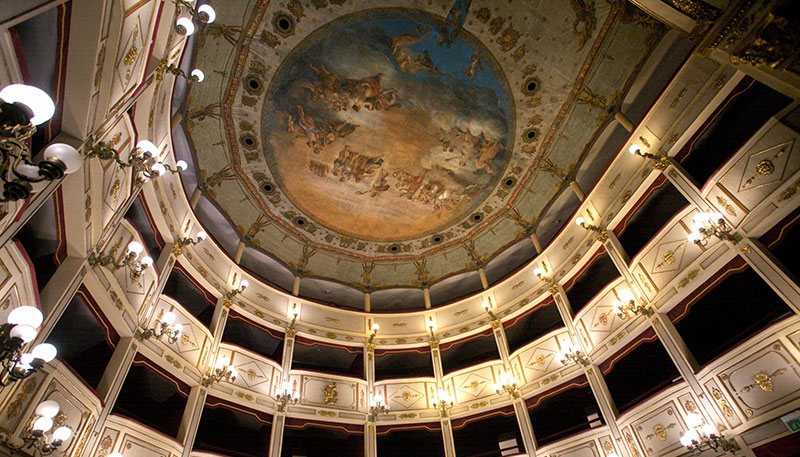
The historic centre of Potenza is located in the highest part of the city, following a medieval layout that is still visible today. Piazza Mario Pagano is its symbolic and civic hub, overlooked by the Francesco Stabile Theatre, an elegant 19th-century building inspired by the San Carlo Theatre in Naples, and the Government Building. From here, Via Pretoria winds its way through the historic centre, the main axis and privileged location of city life, among palaces, shops and social spaces. The side alleys, stairways and open spaces reveal a layered urban fabric, where civil and religious architecture coexist, signs of ancient medieval gates and evidence of a city that has been repeatedly damaged by earthquakes but always rebuilt. At the eastern end of the historic centre stands the Guevara Tower, built by the Lombards before the year 1000, the only survivor of the ancient feudal castle, now an exhibition space and a tangible reminder of the city's fortified past.
The Cathedral of San Gerardo dominates one of the highest and most panoramic points of the city. Built on the site of an earlier early Christian building, it has undergone centuries of transformation to arrive at its current 18th-century neoclassical appearance, designed by Antonio Magri, a pupil of Vanvitelli. Inside, it preserves Roman mosaics, a late antique crypt, the relics of San Gerardo La Porta, bishop and patron saint of the city, a central figure in Potenza's spirituality, and a Roman sarcophagus contemporary with the city's three gates (Portasalza, Porta Amendola and Porta Trinità). Next to the cathedral, the religious heritage is enriched by historic churches such as San Francesco, Santissima Trinità and San Michele Arcangelo, which mark the city's so-called 'sacred route'. The civil heritage is expressed in noble palaces such as Palazzo Loffredo, now home to the 'Dinu Adamesteanu' National Archaeological Museum of Basilicata, and Palazzo Bonifacio, a refined example of 17th-century architecture. The contemporary architectural landscape is dominated by the Musmeci Bridge, an extraordinary feat of engineering built in the 1970s, a pillarless bridge that crosses the Basento river with fluid, sculptural forms, now protected as a monument of cultural interest. The Roman Villa of Malvaccaro provides an insight into agricultural and productive life in the imperial age, while the Diocesan Museum houses sacred works of art and precious documents of Lucanian religious history. Completing the provincial cultural network, the Provincial Archaeological Museum - which also includes the Provincial Art Gallery and the Covo degli Arditi - is one of the oldest museums in the region, founded in the early 20th century to preserve the materials unearthed during the excavations at Metaponto, integrating archaeology, figurative arts and historical memory.
The history of Potenza also lives on in its popular traditions. Every year, on 29 May, the city celebrates its patron saint with the evocative Sfilata dei Turchi (Parade of the Turks), a historical re-enactment that blends the sacred and the profane and involves the entire historic centre in a collective ritual of great symbolic intensity.
Today, Potenza is a city in balance between memory and transformation: the administrative and cultural centre of the region, it continues to renew itself without losing its connection with its millennial history and the landscape that surrounds it.
Potenza is the birthplace of many figures from the cultural, legal, artistic and literary scene of Basilicata. Among these, the following stand out: the historian Tommaso Pedìo, one of the leading scholars of Southern Italy, Basilicata and brigandage; Vito Riviello, one of the most original Italian poets of the second half of the 20th century; Rocco Antonio Luigi Busciolano, an Italian sculptor active in Naples and Basilicata; Emilio Colombo, one of the leading figures in 20th-century Italian politics; Ettore Ciccotti, historian of antiquity, political scientist and politician; Riccardo Dalisi, architect, designer and artist; Orazio Gavioli (1871 - 1944), botanist and surgeon; Orazio Gavioli (1934 - 1997), journalist, author and presenter, known for his work at Rai and as head of the entertainment section of the daily newspaper La Repubblica. And then there is the poet, screenwriter, director and journalist Gian Domenico Giagni, the mezzo-soprano Anna Bonitatibus, the poet and patriot Emilio Maffei, the painters Mauro Masi and Italo Squitieri, the jurist and poet Giulio Stolfi, the painter and sculptor Nino Tricarico, the physicist Benedetto Vigna, and many athletes and sportsmen such as the weightlifter Donato Telesca, footballer Giuseppe Catalano, racing driver Rocco Mazzola, swimmer Domenico Acerenza, and the well-known television presenter Peppone (Giuseppe) Calabrese.