

Pignola
An ancient village surrounded by woods, lakes and mountains
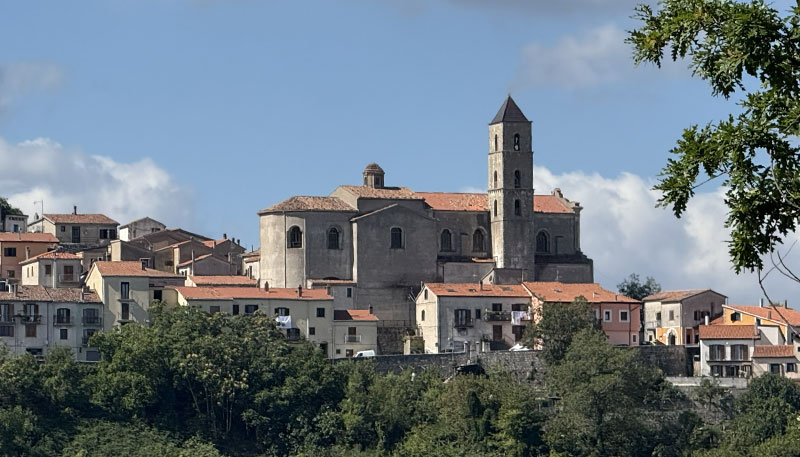
Perched on a hill over 900 metres high and just a few minutes from Potenza, Pignola appears as a village climbing towards the summit, following concentric circles that become narrower and narrower as you ascend. All around, a natural amphitheatre of mountains - part of the Maddalena chain - embraces the upper Basento valley, while the lush greenery of the Lucanian Apennines Val d'Agri Lagonegrese National Park surrounds the village like a cloak. Dense forests of beech, chestnut, spruce and fir trees envelop the area, while the Pantano plain offers a green respite that is home to one of the most precious places in Basilicata: the Lago Pantano Regional Nature Reserve.
Pignola, once called 'Vineola' or 'Vignola' (from the Latin vinea - vineyard), has its roots in the year 1000, when it appears in the catalogue of Norman barons. The frescoes rediscovered in the Church of San Donato - formerly San Nicola - depicting saints and Christ on horseback, suggest that they were painted by artists accompanying the Crusaders, one of the most fascinating testimonies to the early vitality of the village. In the 13th century, Frederick II recognised the solidity of the town: it was he who ordered the inhabitants of Vineola to restore the castle of Lagopesole, one of his favourite manors. But the most glorious period came in the 15th century, with the presence and protection of Queen Joanna II of Anjou, who granted privileges, donated relics and enriched the Mother Church, also assigning the land of Vignola to the Casa Santa Ave Gratia Plena in Naples. In 1928, Pignola was annexed to Potenza, but, with typical Lucanian stubbornness, it regained its autonomy in 1935.
Those who arrive here immediately breathe in the fresh air of the mountain villages and discover a place that lives on stone, history and nature. The houses, clinging to the hillside, are connected by narrow alleys and stairways that lead to the most panoramic point: the Mother Church of Santa Maria Maggiore, one of the most majestic in the region. Rebuilt in the 18th century, the current structure was the work of a pupil of Vanvitelli, built on the ruins of a 13th-century Romanesque building, and still preserves a precious 15th-century bell tower and a treasure trove of art consisting of canvases and paintings by the Lucanian artist Giovanni De Gregorio, known as Pietrafesa, who died in Pignola in 1653. It is from this vertical architecture that Pignola has earned another name: the village of a hundred portals, although in reality there are many more, true stone masterpieces that dot the village and transform it into an open-air museum that accompanies visitors through centuries of stonemasonry. Each portal speaks a different language, such as the Ciasca, rich in volutes and cartouches with two disturbing masks on either side; the Pecoriello, guarded by two small lions and children's faces set in stone; the Padula, adorned with a column resting on a stone lion and surmounted by a balcony supported by anthropomorphic corbels with a remarkable wrought iron railing; or the Patrone, recognisable by the wave of its piers and the parchment engraved with names and dates.
The Church of Sant'Antonio Abate is striking for its splendid 18th-century portal and the Porta del Giubileo, a bronze work by Antonio Masini. Here, on 16 January, the village comes alive with the Palio di Sant'Antonio, a sacred and profane ritual that brings horses and mules racing along the steep alleys of the village. The Church of San Rocco, with its 17th-century portal, houses a bronze door dedicated to John Paul II, the work of sculptor Marco Santoro.
And in Pantano, between the lake and silence, stands the Sanctuary of the Madonna degli Angeli (also known as Madonna del Pantano), the spiritual heart of the people of Pignola, a place of faith that houses the precious wooden statue of the Madonna degli Angeli (1577-1587), the work of Geronimo Arnone, whose features move the viewer with the sweetness of her face, her blue starry mantle and the blessing Child resting on the Virgin's knees. In May, the statue is accompanied to the Mother Church of Pignola with the traditional procession of the 'Uglia', passing through the streets of the village between imposing bonfires of broom, the 'fanoie', veritable barriers of fire that slow down the procession in a ritual that represents the eternal struggle between good and evil. The bearers, amid dancing and wine, cross the burning embers in a crescendo of emotion that transforms the procession into a powerful representation of identity. In September, the Madonna returns to the Sanctuary.
Among the illustrious figures of Pignola is Michele Coiro (Pignola, 1925 - Rome, 1997), a prominent magistrate, protagonist of Roman judicial life in the second half of the 20th century, member of the Superior Council of Magistrates and, in the 1980s, deputy prosecutor and then head of the District Anti-Mafia Directorate of Rome. In 1994, he was appointed chief prosecutor of the capital and promoted extensive legal action against corruption in public administration. He died suddenly in Rome in 1997 from a stroke; he was given a state funeral, reflecting his institutional importance.
This village is also the birthplace of the well-known singer Arisa, pseudonym of Rosalba Pippa, singer-songwriter and television personality. Born in Genoa but raised in Pignola, her musical career is characterised by a continuous stylistic evolution, from the light pop of her early days to more mature and introspective sounds. Today she is considered one of the most versatile and recognisable performers of contemporary Italian music.
Pignola is a picture postcard you don't expect: a village in Basilicata that has retained all the charm of the mountains, but which is firmly focused on tourism, culture and promoting its beauty.