

San Chrico Raparo
Among rocks, woods and springs: a village suspended above the upper valley
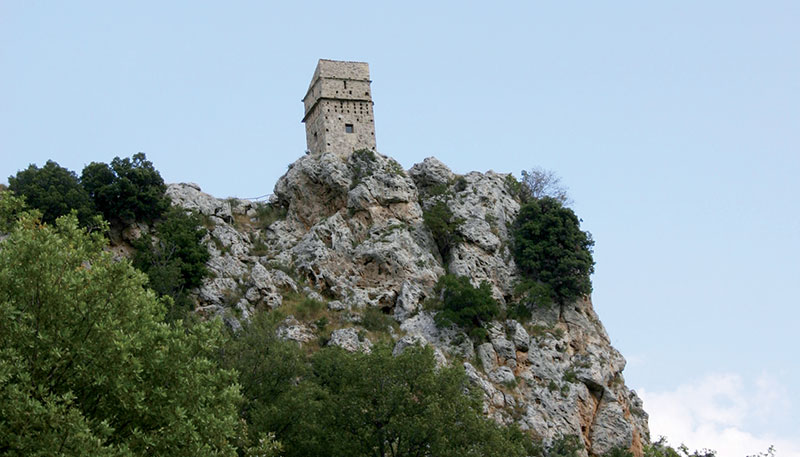
Nestled in the heart of the Lucanian Apennines National Park Val d'Agri Lagonegrese, San Chirico Raparo appears as a small village perched on a rocky spur overlooking the upper valley of the Racanello stream, a tributary of the Agri. The village reveals itself through a dense network of alleys, small squares and sudden glimpses, watched over by the Tower of San Vito, an ancient medieval sentinel overlooking a vast and silent landscape. All around, nature paints a scene of rare beauty: dense woods, crystal-clear springs and mountainous reliefs that change colour with the seasons. The Sella del Titolo forest, with its large turkey oak, beech, chestnut and English oak trees, is a constant invitation to walk and hike, while nearby, the source of the Trigello stream fascinates with its karstic behaviour, disappearing in autumn and re-emerging in spring. The slopes of Monte Raparo are also home to the sulphurous waters of Santa Quaranta and Cortignano, known since ancient times for their beneficial properties.
The origins of San Chirico Raparo are intertwined with Italo-Greek monasticism and the Angevin era, when the first settlement developed around a fort that has since disappeared, destroyed by the earthquake of 1857. The name of the village is linked to the cult of San Quirico, a martyr venerated by Eastern monks, while its feudal history saw a succession of illustrious families such as the Sanseverino, Carafa, Spinelli and Pignatelli. During the 18th and 19th centuries, the village experienced a period of economic vitality thanks to the manufacture of cotton and broom textiles, leaving traces that are still visible in the urban fabric. Walking through the historic centre, you will come across stately buildings such as Palazzo Ferrara, with its elegant stone portal, and Palazzo Barletta, which houses period furnishings and tapestries. Of particular interest is Casa Simonetti, which houses a significant collection of Apulian vases dating from the 4th to 3rd centuries BC and a collection of ancient coins, evidence of the area's frequentation in classical times. The remains of the so-called 'castle', actually a quadrangular tower that was once a baronial residence, still fuel popular tales and legends that convey the atmosphere of a Middle Ages suspended between faith, superstition and power.
The religious heritage of San Chirico Raparo is one of the most profound and distinctive elements of the village. The Mother Church of Saints Peter and Paul, with its 18th-century façade, stands on the remains of an older building and houses works of great value, including a 14th-century wooden crucifix, a 16th-century polyptych attributed to Simone da Firenze, a precious Baroque chalice and a 16th-century baptismal font. In the historic centre, you will also find the Church of Santa Maria del Popolo, a former Dominican convent founded around 1513, which houses precious paintings such as a Madonna del Rosario and the SS. Crocifisso from the mid-16th century attributed to Giovanni Todisco, the Chapel of San Giovanni and the well-preserved Chapel of Sant'Anna (late 18th century), which retains its original floor and a refined 18th-century wooden choir loft with a pipe organ. The devotional route continues with the Chapel of Maria Assunta, considered the oldest in the village, probably built on a former pagan place of worship and still full of archaic symbolism, with a travertine holy water font carved in tuff and an unexplored crypt below, which in the past served as a burial place.
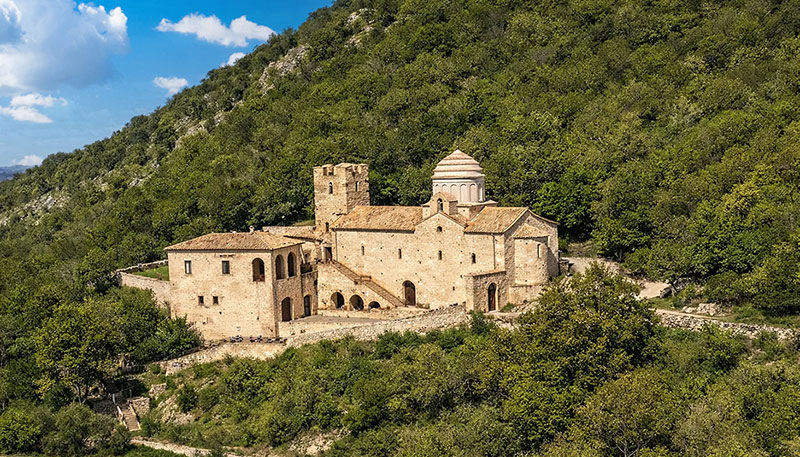
About 7 km from the town centre, climbing towards Monte Raparo, stands the Abbey of Sant'Angelo al Monte Raparo, one of the most important complexes of Basilian monasticism in southern Italy in the 10th century, declared a national monument in 1927. Built over a cave used as the monks' first refuge, it preserves cells carved into the tuff and an ancient fresco of St. Michael the Archangel. The cave, now restored and open to visitors, is also home to one of the most important bat colonies in Europe, combining naturalistic and historical value.
Not far from the Abbey, an ancient and mysterious spring flows from the depths of the rock: the Trigella spring, named after the Latin trigelida, 'icy, very cold', linked to an ancient myth recounted by the humanist poet Giovanni Pontano, who set the story of the nymph Ripenia and the faun Capripede here.
Among the prominent figures born here, we remember the philosopher and psychologist Francesco De Sarlo (San Chirico Raparo, 1864 - Florence, 1937). A lecturer in Florence from 1900 to 1933, he founded the Laboratory of Experimental Psychology and influenced students such as Antonio Aliotta and Eugenio Garin. A critic of the neo-idealism of Croce and Gentile, he advocated the unity of philosophical and scientific methods, based on psychic experience and experimental and introspective methods. Founder of the periodical La cultura filosofica, he also contributed to the magazine Psiche. He was a signatory of the 1925 Manifesto of Anti-Fascist Intellectuals and author of Gentile e Croce. Lettere filosofiche di un 'superato' (Philosophical Letters of an 'Outdated' Person).
San Chirico Raparo thus offers itself to visitors as a place where landscape, history, myth and spirituality merge into a continuous narrative, made up of mountain silences, ancient memories and a surprisingly rich cultural heritage.