

San Martino d'Agri
Where the village embraces the valley and history breathes among the stones
San Martino d'Agri stands on a gentle hill immersed in the green landscape of the Lucanian Apennines National Park Val d'Agri Lagonegrese, where the Agri river flows silently through woods, sandy hills and the evocative Murgia di Sant'Oronzo, whose spectacular pinnacles give life to a deep gorge that recalls, in its grandeur and charm, the great canyons overseas. The territory borders the artificial reservoir of Lake Pietra del Pertusillo, an important environmental oasis and a favourite destination for birdwatching thanks to the presence of numerous species of resident and migratory birds, as well as for sport fishing.
The origins of the village date back to the 9th-10th centuries, when Basilian monks from the East founded the first monasteries and laid the foundations of the medieval settlement. However, some Roman finds discovered in the area testify to an even older presence. In the following centuries, the village came under various dominations: Normans, Swabians, Angevins, and finally the Templars and the Knights of Malta. After a period of decline, at the end of the 15th century it was repopulated by Albanian communities of the Latin rite; later it belonged to the Vergara family and then to the Sifola family of Trani, who retained the baronial title until the 19th century. The current name, San Martino d'Agri, was made official in 1863.
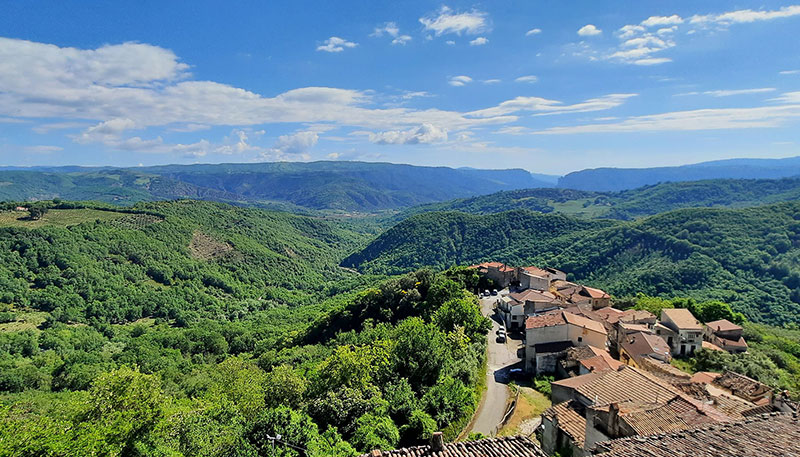
The historic centre has a typical mountain layout, with steep stairways, intertwining alleys and stone houses huddled together. The dominant feature is the Palazzo Baronale Sifola, from which you can reach Piazza Plebiscito, the heart of the village, surrounded by ancient noble palaces. Along the way, you will find Casa Demma, with 19th-century frescoes and a carved stone portal, and Casa Sivolella with the Chapel of the Madonna delle Grazie. Not far away is the Chapel of the Dead Jesus in Via Garibaldi and the house of the poet Teresina De Pierro, embellished with a marble portal dating back to 1853. Descending towards Via Cavour, you will see Palazzo De Frino, with its elegant loggias, while on Via Cola di Rienzo you can admire Casa Franco and a series of narrow streets leading to the town's main church, Chiesa della Madonna della Rupe.
Among the religious buildings, the Church of San Francesco, built in 1512 and renovated in the 18th century, stands out. It houses valuable works of art: a 16th-century altarpiece depicting the Madonna del Rosario, a crucifix and a painting by Giovanni De Gregorio, known as Pietrafesa, from Satriano. The cloister of the Convent of Sant'Antonio preserves frescoes from 1743 attributed to Pietro Giampietro da Brienza, which narrate scenes from the lives of Christ, St. Francis, St. Anthony, St. Clare, St. Roch, and others.
On Mount Raparello stands the Sanctuary of the Santissima Madonna della Rupe, a place of deep local devotion, and next to the sanctuary is the mountain chapel built in 1908, which houses the precious wooden statue of the Madonna della Rupe, carved and gilded, dating back to the 15th century and attributed to an unknown Lucanian artist.
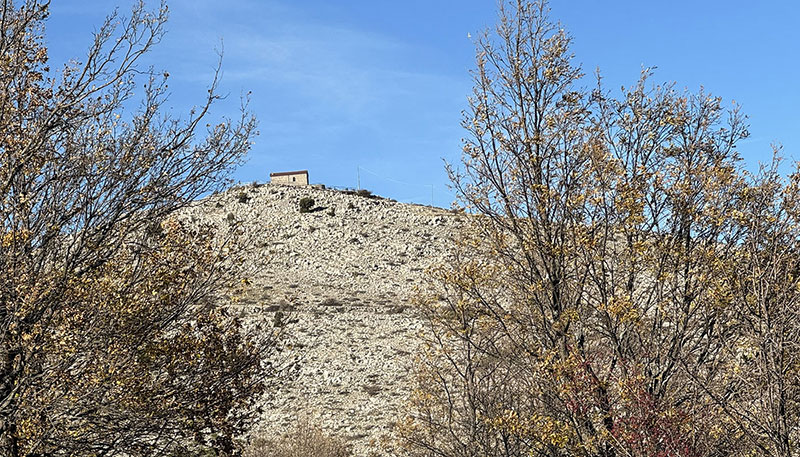
In the surroundings of the village, nature offers hiking trails through oak and chestnut woods, along the Trigella stream and towards the mule track that climbs up to Mount Raparo, where the ruins of the Abbey of Sant'Angelo and the ancient cells carved into the rock with an 11th-century fresco depicting St. Michael are located.
Among the prominent figures of San Martino we remember: the painter Vincenzo Marinelli (San Martino d'Agri, 1819 - Naples, 1892). After participating in the liberal uprisings of 1848, he lived in exile in Greece, and then frequented Italian and European cultural circles. He obtained a teaching position at the Royal Academy of Naples and continued his artistic career until his death; the poet Teresina De Pierro (San Martino d'Agri, 1859 - San Isidro, 1943). She began writing as a teenager, publishing the collection Poesie at the age of 14, followed by Affetti e Memorie, which brought her into contact with Carducci. She collaborated with local and national magazines and newspapers and translated a novella from the Decameron into the Lucanian dialect. She moved to Argentina, where she remained after her husband's death. She died at the age of 85, leaving behind a rich literary contribution linked to her native land.