

Viggiano
Viggiano: city of Mary and music
Nestled on the slopes of two rocky spurs overlooking the green Agri Valley, Viggiano lies in the heart of the Lucanian Apennines Val d'Agri Lagonegrese National Park, in one of the most evocative natural settings in Basilicata. The landscape that accompanies your arrival in the village is a succession of clearings, woods and panoramic viewpoints that tell the story of a changing land, where imposing mountains slope down into rolling hills and fertile plains, criss-crossed by springs and waterways.
The surrounding area offers a valuable environmental heritage: not far away are the Grumentum Archaeological Park, the Alta Val d'Agri Archaeological Museum and Lake Pertusillo, an important nature reserve for birdwatching, and the Abetina di Laurenzana Reserve, with its white fir woods. Trails, trekking routes and cycle paths make the area ideal for slow, conscious tourism in every season of the year.
The origins of Viggiano are ancient and closely linked to the nearby Roman town of Grumentum. After the destruction of the Roman centre, the town was reorganised higher up, favoured by the presence of Basilian monks, who began land clearing works, founded hermitages and churches, and established a deep Marian devotion. During the Lombard and Norman periods, the village took on a fortified character, of which the ruins of the feudal castle, located at the highest point of the village, remain today. Over the centuries, Viggiano experienced Angevin and Aragonese rule, undergoing periods of growth and prosperity that made it one of the most populous centres in the Val d'Agri. After the unification of Italy, it was involved in the post-unification brigandage uprisings, linked to the figure of the Viggiano brigand Giuseppe Miglionico, known as Scoppettiello.
The historic centre retains the typical layout of medieval hilltop villages: narrow alleys, arches, underpasses and houses leaning against each other. Particularly characteristic are the stone portals, decorated with bas-reliefs depicting harps, violins and musical symbols, testimony to the town's great craft tradition.
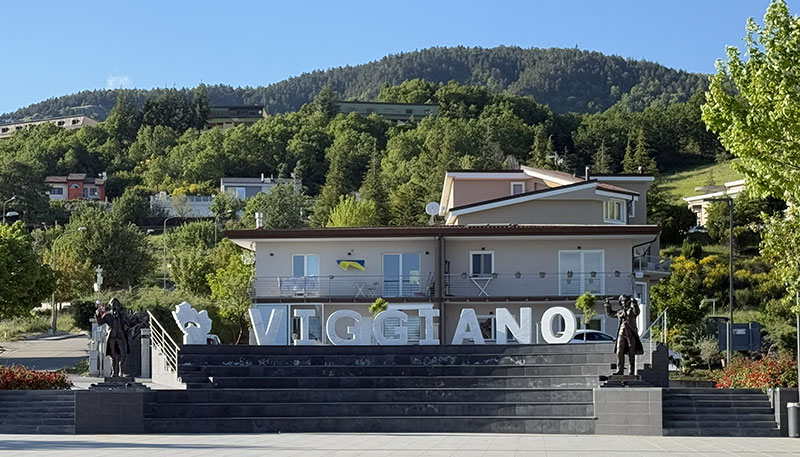
Between the 17th and 18th centuries, Viggiano became famous throughout Europe for the construction of musical instruments, particularly harps, and for its itinerant musicians, among whom the internationally renowned flutist Leonardo De Lorenzo from Viggiano stands out. This tradition lives on today in the Scuola dell'Arpa Popolare Viggianese (Viggiano Folk Harp School), based in the Villa del Marchese, a historic building that belonged to the noble Sanfelice family. Every year in the first week of August, the Rassegna dell'Arpa Viggianese (Viggiano Harp Festival) takes place, offering concerts, seminars and workshops attended by musicians of national and international calibre.
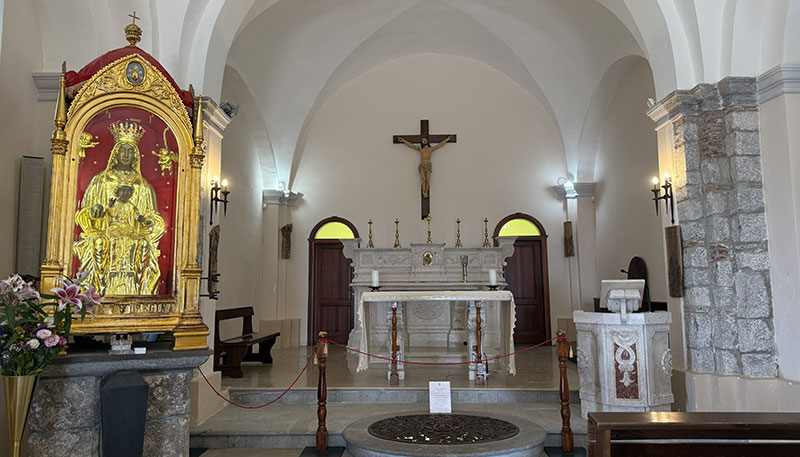
In addition to its civil heritage, Viggiano boasts a rich architectural and religious heritage. Places of worship include the rock church of Santa Maria la Preta, founded by the Basilians in the 8th century; the Convent of Santa Maria del Gesù (15th century), now home to the Museum of Popular Traditions, which houses a valuable wooden choir; the Church of San Benedetto, at the foot of the castle; the churches of San Rocco, San Sebastiano, San Pietro and the Church of Buona Morte, now restored as a theatre. A group of buildings that tells the spiritual and social history of the Viggianese community. The religious heart of the town is the Basilica of Santa Maria alle Mura, also known as the Church of the Deposito, which houses the wooden statue of the Black Madonna, Patroness and Queen of Basilicata. From here, every year, one of the most intense and identity-defining rituals of the region begins: the pilgrimage to Sacro Monte.
And it is on Sacro Monte, at an altitude of 1,725 metres, that the Sanctuary of the Madonna del Sacro Monte (or Black Madonna) stands, the most important Marian centre in Basilicata, probably built around the 11th century. The Sanctuary is linked to a centuries-old double pilgrimage: on the first Sunday in May, the Black Madonna is carried in procession from the town's Basilica to the Sacred Mountain, where it remains throughout the summer; on the first Sunday in September, the statue returns to Viggiano, welcomed by a huge crowd of faithful. The statue depicts the Virgin Mary enthroned with the blessing Child and is covered in pure gold. A theological and artistic symbol of extraordinary value, it represents for the people of Basilicata the synthesis of their history, their faith and their bond with the land.
Don't miss the Southern Italian Bagpipes and Ciaramelle Festival, which enlivens the streets of the historic centre every December with traditional melodies played by itinerant musicians dressed in traditional pastoral costumes.
Among the illustrious figures we remember: the flutist Leonardo De Lorenzo (Viggiano, 1875 - Santa Barbara, 1962). He studied in Naples and, after a period in the United States and Europe, established himself as principal flute in the New York Symphony Orchestra under Gustav Mahler. He taught at the Eastman School of Music, training important flutists such as Julius Baker, and devoted himself to composition and essay writing on the flute. Author of My Complete Story of the Flute (1951), he donated his research material to the University of Southern California; and politician and writer Nicola Basile (Viggiano, 1883 - Genoa, 1979), mayor of Alessandria from 1947 to 1964. Active in the Italian Socialist Party since his adolescence, he was persecuted by fascism and founded the Lucanian newspaper Il ribelle. A teacher for over forty years in Alessandria, he promoted local education and culture. He was the author of numerous writings, including La città mia.
City of Mary, the Harp and Music, Viggiano combines nature, history and faith in a unique balance, offering visitors an experience that goes beyond simple tourist discovery to become a true journey into the soul of Basilicata.