

Tramutola
Where water shapes the landscape and tells the story of the territory
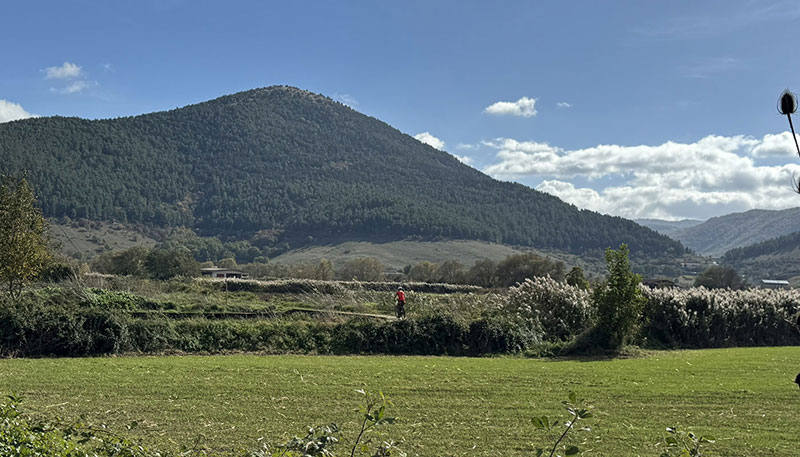
The very name Tramutola reveals its deepest soul: 'land soaked with water' (from 'terra mòtola'). A place name that reflects the reality of a village criss-crossed by springs, fountains and wash houses, many of which are embellished with elegant wrought iron structures, the result of local craftsmanship. The village stands on a rocky hill overlooking the fertile Agri Valley, in the heart of the Lucanian Apennines Val d'Agri Lagonegrese National Park, set in a stunning natural landscape of mountains, rolling hills, cultivated plains and lush forests. The waters, which flow abundantly underground and on the surface, give the entire area a lively and harmonious character, ideal for walks, hikes and slow tourism in contact with nature.
A few kilometres from the town is the Caolo Spring, the true heart of the area. With a flow rate of about 900 litres per second, it is the largest spring in the Val d'Agri and is fed by a complex karst system that conveys the waters of two basins located at different altitudes. Reachable via paths surrounded by greenery, the spring reveals itself to the eye with a spectacular waterfall cascading between the rocks, accompanied by the constant sound of the stream. The surrounding area, rich in biodiversity, is equipped for rest stops and picnics, offering visitors an immersive experience of nature, water and silence.
The origins of Tramutola are linked to an ancient Roman settlement, pagus of the important city of Grumentum, but it was with the arrival of Benedictine monks in the 10th century that the village took on a stable appearance and a central role in the valley. The monks of Cava dei Tirreni built the Abbey of San Pietro, now known as Casa Fiatamone, of which a splendid loggia with 12th-century Romanesque capitals remains, a precious testimony to medieval spirituality and monastic organisation. Their presence encouraged the agricultural and economic development of the area, introducing the cultivation of mulberry trees and silkworm breeding, which, together with the processing of flax and hemp, supported a flourishing textile industry for centuries.
Throughout history, Tramutola came under the rule of important feudal families, including the Counts of Celano and the Sanseverino family, before returning to Benedictine control in 1501 until the early 19th century. The town also played a leading role in crucial events in modern history: in 1799, it was one of the first towns in Basilicata to raise the Tree of Liberty during the Neapolitan Republic and actively participated in the Carbonari uprisings of 1820-21.
The historic centre still retains a charming urban fabric, made up of narrow streets, houses leaning against each other and ancient districts such as San Felice, where you can find 18th-century noble palaces, often of Spanish origin, embellished with loggias and monumental portals. Curious and significant are the small female stone sculptures, symbols of fertility, set on balconies and windows, silent signs of an ancient and deeply rooted popular culture.
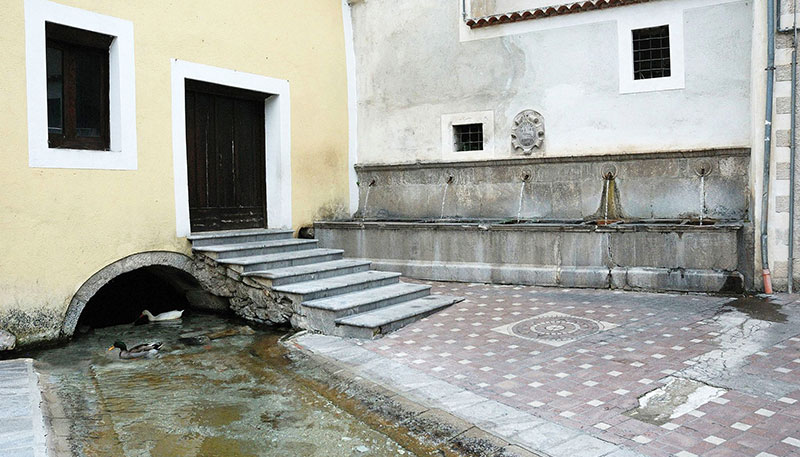
A distinctive feature of Tramutola is the ancient wash house, known as 'Ngap l'acqua', built in the 17th century and fed by a spring that once also powered the adjacent water mill. Located in Capo d'Acqua, the building is bordered by a stone fountain with masks. This place, which for centuries has been a meeting place and social hub for women, became known to the general public thanks to Rocco Papaleo's film Basilicata Coast to Coast, which set one of the film's most iconic scenes here, defining Tramutola as the village 'of the most beautiful girls in Basilicata'. The link with cinema has helped to reinforce the image of the village as an authentic place, capable of preserving traditions and at the same time telling its story with irony and lightness.
The centre of devotion and religious identity in Tramutola is the Mother Church of the Madonna dei Miracoli, located outside the town walls, a choice that reflects the particular history of the Benedictine settlement. The building houses an artistic heritage of great value: the 1569 polyptych attributed to Antonio Stabile stands out, depicting the Deposition with St Cataldo, St John and Pentecost, flanked by a canvas of the Coronation of the Virgin and a valuable 17th-century wooden choir. On the high altar is a wooden statue of Our Lady of Miracles, dating back to the 15th century, which is the object of deeply rooted devotion.
The village's most solemn festival is celebrated on 16 and 17 May and is linked to an event considered miraculous: in 1853, during a severe drought, the statue of the Madonna, carried in procession, is said to have moved backwards several times on its own, while the bearers felt a mysterious force. Shortly afterwards, a reddish flame appeared on the statue's chest and, the following day, the long-awaited rain arrived. Since then, the Madonna dei Miracoli has been considered the protector of the countryside and the community.
This devotion is accompanied by a particularly evocative ritual: on the last Sunday in May, the procession of the 'Madonna in the Boat' takes place, in which the statue is carried on a boat made of roses, symbolising the hopes of emigrants who entrusted their dreams of a better future to the journey.
Also noteworthy is the Church of Our Lady of Loreto (15th century), originally built as a chapel for the Troccoli family. It is a small church with a single nave that preserves frescoes of great interest, including a Madonna del Latte, Saint Catherine and Saint Lucy, dating from between the 15th and 17th centuries. Restored between 2009 and 2010, it is one of the oldest pictorial testimonies in the village. The Church of the Santissimo Rosario (1575) houses a monumental carved and gilded wooden altarpiece (1671), decorated with representations of the Mysteries of the Rosary and culminating in the scene of Paradise.
Among the figures who have brought prestige to Tramutola are: the composer Vincenzo Emidio Carmine Ferroni (Tramutola, 1858 - Milan, 1934), who composed operas such as Ettore Fieramosca and Il Carbonaro, as well as symphonies, sacred music and chamber music; the Archbishop and Benedictine monk Anselmo Filippo Pecci (Tramutola, 1868 - Cava de' Tirreni, 1950), who was called the 'Leonine bishop' for his culture and attention to the poor; the actress, writer and screenwriter Neda Naldi, pseudonym of Italia Volpiana (Tramutola, 1913 - Rome, 1993), who had a long artistic career in cinema, theatre and television; and the historian and politician Andrea Lombardi (Tramutola, 1785 - Potenza, 1849).
Tramutola thus presents itself as a village of water and memory, where nature, history, art and spirituality intertwine in a coherent and fascinating narrative, capable of engaging visitors and restoring the deep soul of the Val d'Agri.