

Spinoso
A village with ancient charm
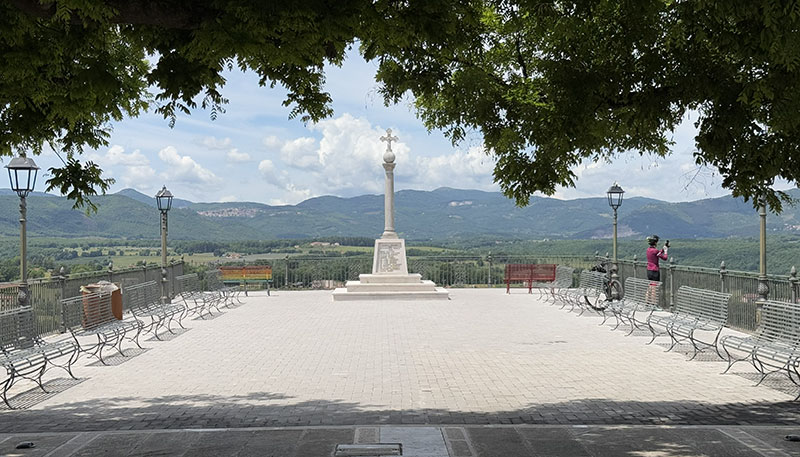
Nestled in the hills of Val d'Agri, in the heart of the Lucanian Apennines National Park Val d'Agri Lagonegrese, Spinoso is a large natural viewpoint overlooking the waters of Lake Pietra del Pertusillo, an important environmental oasis and a favourite destination for birdwatching thanks to the presence of numerous species of resident and migratory birds, as well as for sport fishing. It is surrounded by extensive woods that amplify the sense of tranquillity and harmony with the landscape. The lake is an artificial reservoir built in the 1960s, with a 380-metre-long and 95-metre-high arch-gravity dam. The lake's location at the foot of Monte Raparo (1810 m), one of the most evocative peaks of the Lucanian Apennines, offers fascinating hiking trails, making Spinoso an ideal destination for those who love slow rhythms, nature walks and discovering authentic places, far from the large tourist flows.
The origins of the village are closely linked to the history of ancient Grumentum, an important Roman city in the valley. Following the Saracen raids that caused its destruction, part of the surviving population took refuge on the slopes of Mount Raparo, giving rise to a new settlement that is already attested in the Catalogue of Barons (12th century) under the name 'Spinosa'. The name derives from the Latin spina, indicating an area rich in spontaneous vegetation. Over the centuries, Spinoso was a fiefdom of various noble families - from the Sanseverino to the Spinelli di Fuscaldo - who marked its urban and social evolution until the abolition of feudalism in 1806.
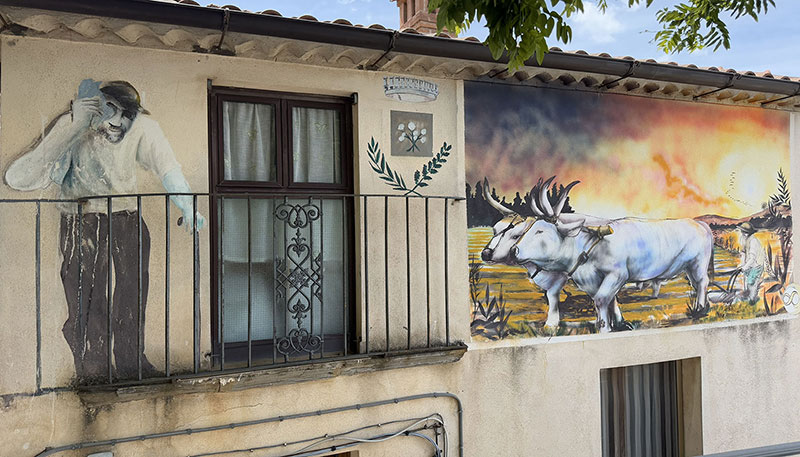
The historic centre still retains a clearly recognisable medieval layout. From the main ridge, you climb towards the highest part of the town, where the Minutolo Baronial Palace and the Mother Church of Santa Maria Assunta, built in the first half of the 16th century on the site of a previous Basilian temple, stand out. Around these buildings is a dense network of narrow, irregular alleys, designed to break the force of the winds, which slope down towards the valley until they meet an ancient ring road with the remains of fortifications and tower houses. Along this route, there is a succession of noble palaces built or remodelled between the 15th and 19th centuries, characterised by terracotta façades and monumental portals in Padula or local stone, true works of art that bear witness to the excellence of the ancient stonemasons' workshops. It is precisely this architectural wealth that has earned Spinoso the nickname 'Borgo dei portali' (Village of Portals).
The heart of city life is Piazza Plebiscito, formerly called Piazza della Croce, due to the presence of a 16th-century stone cross. The square has an elegant semi-circular layout and is dominated by important noble buildings such as the neoclassical Palazzo delle Colonne and Palazzo Romano, while not far away is Palazzo Ranone, an 18th-century building that now hosts cultural and literary events. Also of great importance are Palazzo Caputo, with its adjoining park, and the so-called Palazzuolo Romano, which in the 19th century housed the famous 'Scuola Romantica Spinosese', one of the most prestigious schools in southern Italy, attended by leading figures of Lucanian culture such as Giacinto Albini, Giacomo Racioppi and Michele Tedesco.
Among the places of worship, the Mother Church of Santa Maria Assunta is a veritable treasure trove of sacred art, with a 14th-century holy water font, a painting of the Madonna delle Grazie by Antonio Francesco Delfino, a reliquary bust of St. Mary Magdalene (16th century), wooden altars, paintings and works covering a chronological span from the 12th to the 19th century. Not far away is the Church of San Rocco del Popolo, which preserves a pictorial heritage of great value: on the high altar stands out the large canvas depicting San Rocco praying and the Holy Family, the only religious work by Michele Tedesco, a Macchiaioli painter of European renown, born in Moliterno but raised in Spinoso by his uncle, Abbot Antonio Racioppi. Along the side walls are 19th-century frescoes dedicated to the miracles of the saint.
Completing the cultural and spiritual offering of the area is the rural sanctuary of Santa Maria dei Termini, located about five kilometres from the town. The chapel, restored and returned to worship in 2023, stands on the border between the territories of Spinoso and Sarconi, hence the name 'Termini'. Its origin is probably linked to the ancient route of the Via Herculia, an important Roman road that connected Sannio to Lucania.
Spinoso is a village rich in history, art and traditions, combining the beauty of the natural landscape with a layered and still vibrant cultural heritage, offering visitors an authentic experience in the heart of Basilicata.