

Moliterno
Among ancient buildings and illustrious figures
Moliterno lies on the slopes of the Lucanian Apennines within the national park of the same name, surrounded by dense beech woods, clear springs and ancient sheep tracks that once connected the villages of the valley. The landscape is a mix of imposing woods, streams and waterfalls, making this area a real treasure trove of biodiversity and an ideal place for those who love hiking, cycling and nature trails. The Beech Forest, now a nature reserve and Site of Community Interest, is home to beech trees over forty metres tall. The reserve, located between Val d'Agri and Vallo di Diano, is home to a rich flora - with over 790 species recorded, including rare orchids - and a varied fauna. The area, almost entirely covered by forests and natural grasslands, is one of the most important biotopes in the western part of Basilicata.
The history of the village revolves around the majestic medieval fortress that dominates the town with its twenty-five-metre-high tower. Considered an 'eternal structure', it gave rise to the ancient name Moleterna, which was later transformed into the current Moliterno. The current urban layout developed after the destruction of Grumentum between the 9th and 10th centuries, when some survivors found refuge around the Lombard tower, creating a new settlement that underwent Norman, Swabian, Angevin and Aragonese rule. At the foot of the castle, visitors are welcomed by the Mother Church, rebuilt in the 18th century on a pre-existing 14th-century structure. The interior houses works of great value: a 16th-century panel depicting St. Peter, a Deposition by the Laurenzanese painter Francesco Antonio Romano and refined silver liturgical furnishings. Also worth visiting are the Sanctuary of the Madonna del Vetere, located not far from the village on the site of an ancient pagan temple dedicated to Silvanus and Diana the Huntress, which houses 16th- and 17th-century frescoes from the Neapolitan school; the Church of the Rosary, enriched over the centuries by Dominican conventual interventions, and the Church of Santa Croce, which houses a precious Deposition by Giovanni Di Gregorio, known as Pietrafesa, one of the greatest Lucanian painters of the 17th century, on a grandiose wooden altar.
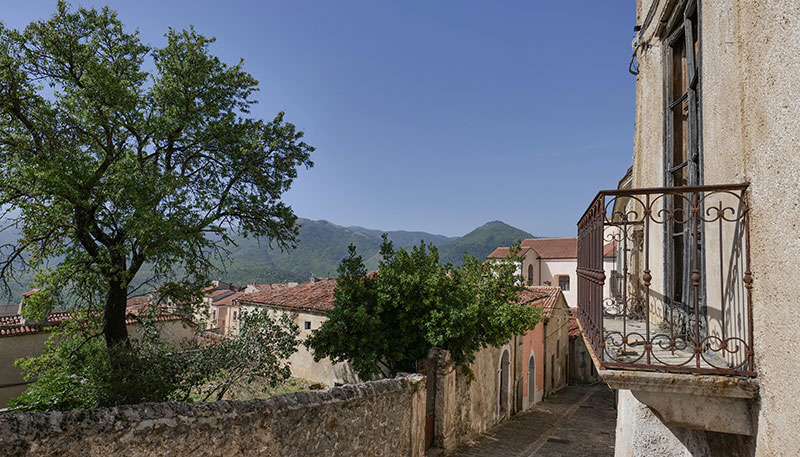
Considered one of the most original villages in Lucania, it still preserves numerous noble palaces that are perfectly recognisable in their feudal architecture: Palazzo Parisi, Palazzo Giliberti, Palazzo Lovito and Palazzo Mobilio Giampietro, famous for the enigmatic inscription 'Soli Deo' engraved in the cloister, the same that recurs in the manuscripts of Johann Sebastian Bach.
Moliterno is home to the prestigious MAM - Musei Aiello Moliterno, one of the most comprehensive museum complexes in Basilicata, making this village a surprising cultural centre. Six museums are distributed in historic buildings that have been restored for public use, each dedicated to a different aspect of Lucanian cultural and artistic production (and beyond): the Landscape Museum, with a collection ranging from views of the Posillipo School to foreign painters of the Grand Tour; the Michele Tedesco and 19th-Century Lucanian Museum, which brings together masterpieces from 19th-century Lucania, from Tedesco to Di Chirico, from Brando to Marinelli and Petroni; the Museum of Contemporary Art, which houses artists such as Marini, Hartung, Tàpies, Pistoletto, and Lucanian artists such as Cerone and Dalisi; Museum of Nineteenth-Century Lucanian Art, with works by Guerricchio, Masi, Squitieri and other artists; Museum of Twentieth-Century Ceramics; Museum of Modern Art, which houses design objects; Angela Aiello Lucanian Library, which houses a collection of books and prints on Basilicata from the seventeenth century to the present day.

Also worth visiting is the Grumentum Archaeological Park, an ancient Roman colony, with the National Archaeological Museum of the Upper Agri Valley, located a short distance from Moliterno.
Renowned for the production of the famous Canestrato IGP cheese, Moliterno is also home to many illustrious figures: the writer, patriot and politician Ferdinando Petruccelli della Gattina (Moliterno, 1815 – Paris, 1890), a pioneer of modern journalism; the general and military engineer Marquis Giuseppe Ruggiero Parisi (Moliterno, 1745 – Naples, 1831), Chief of Staff of the Army of the Two Sicilies and founder of the Accademia della Nunziatella; the historian and economist Giacomo Racioppi (Moliterno, 1827 - Rome, 1908) and painter Michele Tedesco (Moliterno, 1834 – Naples, 1917), one of the leading figures in 19th-century Lucanian painting.