

Sasso di Castalda
Where nature dominates the landscape
Perched at an altitude of 959 metres, among the mountains that mark the natural border between Potenza and Val d'Agri, Sasso di Castalda is a village that seems to spring directly from the rock above it. Its name says it all: a mighty, almost protective 'rock' that dominates the village and has inspired its identity since its ancient name of Petra Castalda, the 'fortified stone'.
The municipal area is part of the extraordinary scenery of the Lucanian Apennines Val d'Agri Lagonegrese National Park, home to an astonishing biodiversity. Here, the landscape alternates between silent ridges, dense woods and valleys carved out by water, offering ever-changing views in every season: the soft green of spring, the golden fields of summer, the warm colours of autumn and the snow-white silence of winter. The green heart of the area is the Bosco della Costara, a high-altitude beech forest that exceeds 1,000 metres in altitude. Inside the forest is the Oasi del Cervo, a wildlife area where you can observe deer in semi-freedom, especially during the autumn rutting season.
Sasso di Castalda is now one of the most popular destinations in Basilicata for lovers of slow tourism and outdoor activities. The Sentiero Frassati della Basilicata, one of thirteen in Italy, runs entirely through the area. It is a circular route of about 22 kilometres that passes through natural environments, historical sites and places of profound spirituality. The trail winds its way through springs such as Acqua Ceresola, ancient farmhouses, shady woods and panoramic viewpoints such as Monte Arioso and Tempa d'Albano, until it reaches iconic places such as the Mulino del Conte and the majestic Faggio di San Michele, a natural monument whose estimated age ranges between three and four centuries, a symbol of resistance and the secular sacredness of the forest. Each section tells a different story of how to experience the area: the shepherds' path, the wheat path, the church path, the snow path, which is also suitable for cross-country skiing in winter. Monte Arioso also has a well-equipped ski area, connected to Sellata, with ski lifts and slopes suitable for families and beginners, making the village an interesting destination all year round.
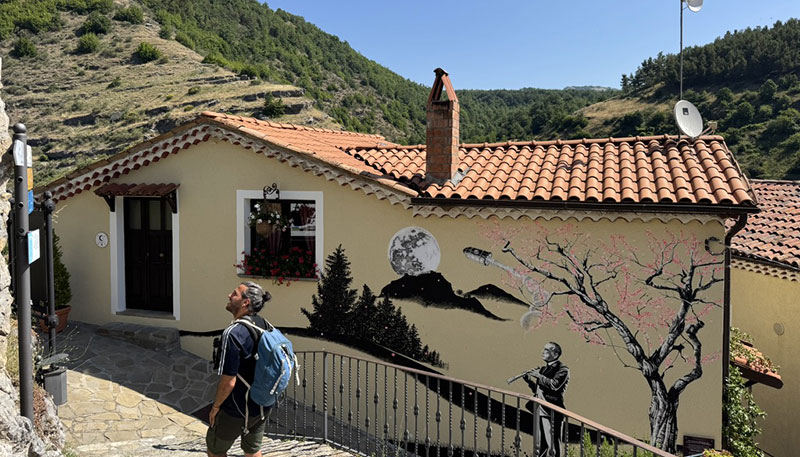
The origins of Sasso di Castalda date back to Roman times, as evidenced by the passage of the Via Herculia, an important road connecting Venosa to Grumentum, through its territory. In the Middle Ages, the village took on a strategic and defensive role, passing under the control of numerous feudal families: from the Normans to the Swabians, from the Angevins to the Caracciolos and the Gaetani d'Aragona counts, who retained possession of it until the 19th century. All that remains of its fortified past are the ruins of what is traditionally called the 'castle', which is actually a watchtower built on a huge rock, more suited to defence than habitation. The ancient village developed around this nucleus, a maze of alleys, stairways and stone houses embellished with flower-filled balconies, where time seems to have stood still.
The spiritual heart of the village is the Mother Church of the Immaculate Conception, overlooking the main square. The building, dating back to the 19th century, stands out for its elegant Baroque portal and an interior rich in works of art: among these are 17th-century paintings attributed to the school of Pietrafesa, a 14th-century statue of the Madonna and Child, a carved confessional in Renaissance style and 17th-century frescoes. Next to the mother church are other small places of worship that dot the urban fabric. The Church of Sant'Antonio houses a wooden sculpture of the saint dating back to the early 16th century, while the Church of San Rocco, built around 1656 and dedicated to the patron saint of the town, is recognisable for its 19th-century bell tower and its strong link with popular devotion, which culminates every year in the festival on 16 August.
A contemporary symbol of Sasso di Castalda is the Ponte alla Luna, a spectacular Tibetan bridge with a plank walkway that is one of the longest in Europe. Suspended over the Arenazzo canyon, the bridge offers a unique experience: walking between sky and rock, at a height of over one hundred metres, with a dizzying view of the gorges below. The route starts from the historic centre, crosses the Ponte Petracca and culminates in the long crossing of the Ponte alla Luna, a work that combines modern engineering and unspoilt landscape.
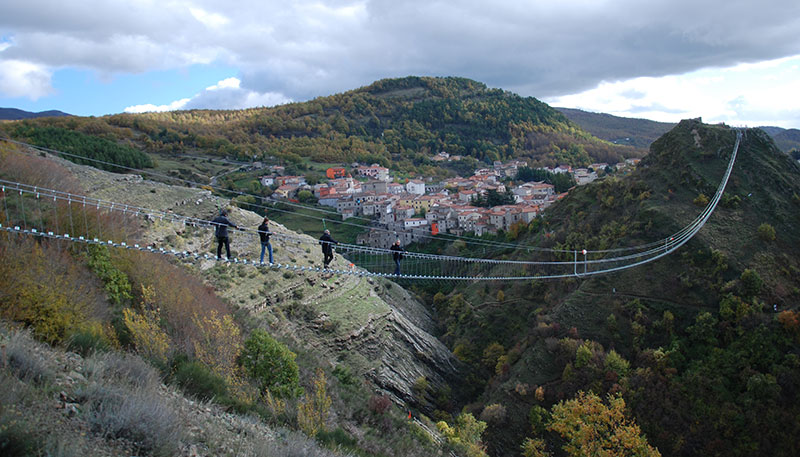
It is not only an adrenaline-fuelled attraction, but also a different way of interpreting the territory, observing it from above, in silence, allowing its primordial force to wash over you: an ideal tribute to the genius and vision of Rocco Petrone, a native of Sasso, NASA engineer and director of the Apollo Programme, to whom the entire route is dedicated.
Other notable figures whose origins can be traced back to this village include: Don Giuseppe De Luca (Sasso di Castalda, 1898 - Rome, 1962), priest, publisher and one of the most refined intellectuals of the 20th century, to whom a Literary Park is dedicated, housed in the ancient family palace, now a venue for cultural events and home to a precious library; the jurist and politician Rocco Beneventano (Sasso di Castalda, 1777 - Naples, 1852), who held important administrative positions under the governments of Giuseppe Bonaparte and Gioacchino Murat; the musician Mariele Ventre (Bologna, 1939 - Bologna, 1995) - her father was originally from Marsico Nuovo and her mother from Sasso di Castalda - founded the Piccolo Coro dell'Antoniano choir, which took her name upon her death: Piccolo Coro 'Mariele Ventre' dell'Antoniano.